
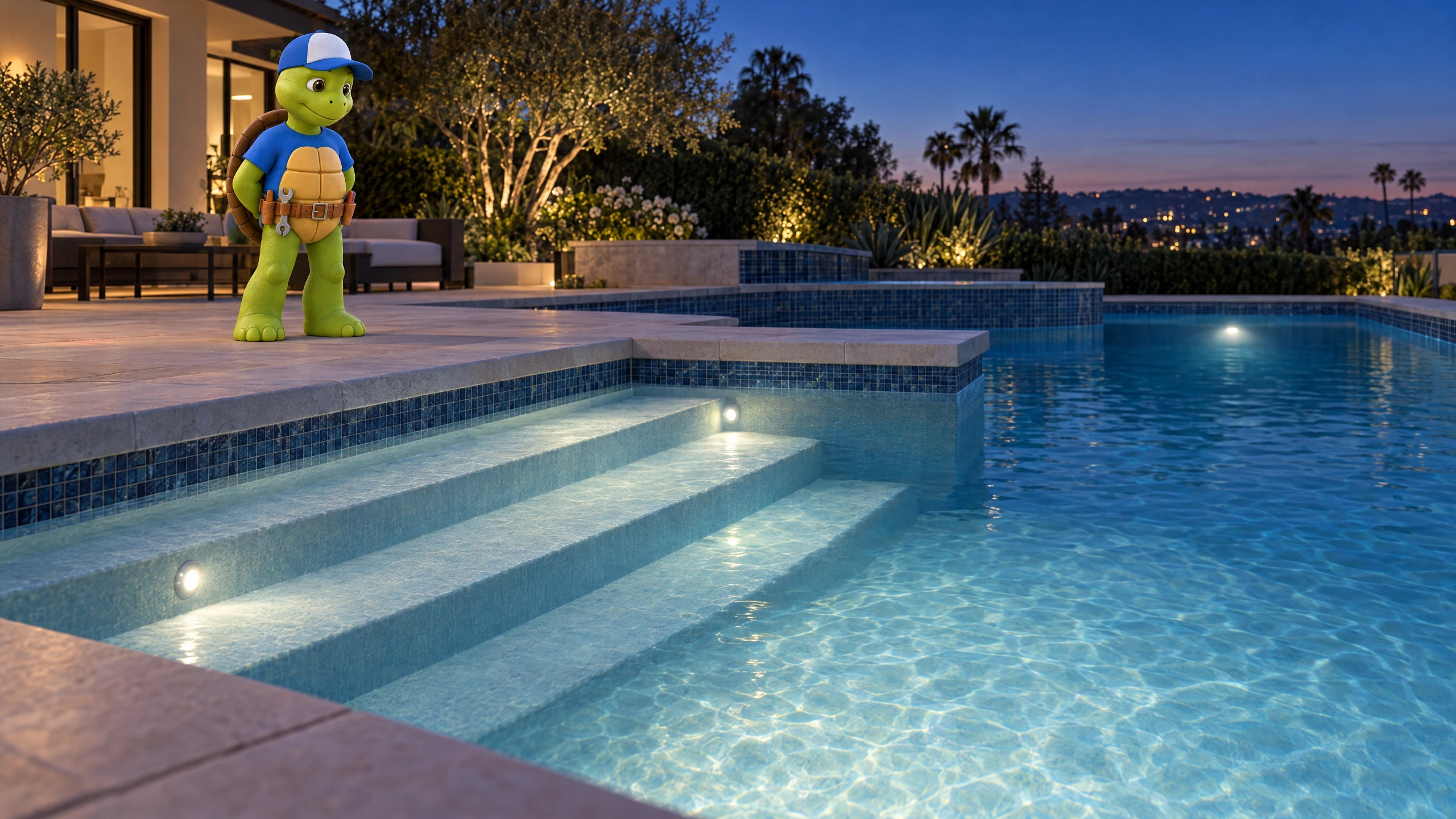
Adding More Lights to a Pool That Already Has One
Most pools got one light in the deep end and called it done. Here’s what adding pool lighting to a finished pool actually involves.
Lens Depth on a Niche Light
Wall Fitting for Small LEDs
Height for Fixtures Within 5 ft
Less Energy Than Incandescent
Turn on the pool light at night and look at the shallow end. The deep end glows, the steps are a dark shape, and the far corner looks like it might have something living in it. That’s the one-light pool, and a lot of Ventura County backyards have one. Adding pool lighting to a pool that’s already built is one of the pool equipment upgrades people ask about once they start using the yard at night.
If your one light is dead or still an old incandescent, that’s a different job, and our post on pool light replacement covers costs, LED swaps and the GFCI question. This post is about adding more light to a pool that already has one.
You can add lights to an existing pool, but the type matters. A traditional niche light needs a housing built into the pool shell, which means cutting into the plaster and concrete, so it’s best done during a replaster or remodel. Nicheless and small LED lights mount in a standard 1.5 inch wall fitting instead of a big niche, which makes them the usual retrofit choice. The hard part with either is getting a cord path from the light to a junction box on the deck. Lights around the pool, like landscape and path lights, follow California Electrical Code distance rules.
Why one light leaves dark corners
Builders put the light where it’s cheapest to plumb and wire, which is usually one wall in the deep end, aimed across the pool. It lights the middle fine. It throws shadows behind steps, benches and the tanning ledge, and it barely reaches the shallow end on a long pool.
The fix isn’t a brighter single light. It’s a second or third light pointed at the parts the first one misses. More light from more angles flattens the shadows, and the pool looks bigger at night.
Niche lights: the traditional route
A niche is the can built into the pool wall that the light sits in. Pentair’s IntelliBrite 5G manual says the light must only be used with Pentair niches, and that it has to be mounted so the top of the lens is at least 18 inches below the water surface.
On a pool that’s already built, adding a niche means cutting a hole in the shell, setting a new niche, bonding it, running conduit to the deck and patching the plaster. That’s real construction. It’s also why the honest answer is to time it with a replaster, when the plaster is coming off anyway.
If a replaster is on the horizon, our posts on what a full pool replaster costs and what to replace first in a remodel are worth reading before you decide where the lights go.
Plan lights before the plaster crew shows up. Once a new finish is on, adding a niche means cutting into a surface you just paid for. A light that costs a little extra during a replaster costs a lot more after.
Nicheless pool lighting: the retrofit route
Nicheless lights skip the big can. Pentair says its MicroBrite LED is 3.5 inches long, runs on 12 volts, and needs no niche because it “installs in any standard 1.5 inch pool wall fitting.” Jandy describes its Nicheless LED lights the same way: they mount to 1-1/2 inch fittings and need no bonding or traditional niche.
That’s why these are the go-to for adding light to an existing pool. They’re small enough for steps, benches and spa walls, where a full-size light would look like a headlight.
The light is the easy part. What has to happen behind it is where the work is.
Getting the cord from the light to the deck
Every underwater light has a cord, and that cord has to run through a pipe to a junction box above the water. On a new build, that pipe goes in before the concrete. On an existing pool, someone has to create a path.
Sometimes there’s an old fiber optic conduit or an unused fitting that can be put to work. Jandy actually pitched its Nicheless lights as a retrofit for fiber optic systems. Sometimes there’s nothing, and the deck has to be opened to run a new line.
This is the question that sets the price. Two pools with the same lights can be very different jobs depending on what’s under the deck.
The light is the easy part. The pipe behind it is what you’re really paying for.
Transformers, circuits and the panel
Most small and nicheless lights are 12 volt. Pentair’s IntelliBrite manual says 12 volt lights need a separate step-down transformer, and that line voltage lights need a GFCI. If your existing light is 120 volt, a new 12 volt light usually gets its own transformer near the equipment pad.
Check whether there’s room in the panel or the pad’s subpanel, and if the automation has a spare relay for the new lights. Running new circuits is electrical work, so ask your city’s building department whether it needs a permit.
Lights around the pool, not in it
Path lights, step lights in the deck and lights in the planters do a lot for a pool at night, and they don’t involve cutting into the shell. They do have rules.
Contra Costa County’s pool and spa installation handout, which cites the 2022 California Electrical Code, says fixtures over the pool or within 5 feet of it must be at least 12 feet above the pool. Fixtures between 5 and 10 feet from the pool and under 5 feet high need GFCI protection.
Translation: no cute little post lights right at the coping. Keep them back, or talk to an electrician about what’s allowed close in.
Keep the colors on speaking terms
If your current light is a color LED, the new ones should usually be the same brand. Color shows and syncing are generally built around a brand’s own lights and automation. Mix brands and you can end up with one light on blue and the other on whatever it felt like.
Same goes for white. Warm white and cool white side by side looks like a mistake. Pick one and match it.
LED is the only sensible choice now
The Department of Energy says residential LEDs use at least 75 percent less energy and last up to 25 times longer than incandescent lighting. Southern California Edison’s time-of-use plans charge the most on weekday evenings, which is exactly when pool lights are on.
If you’re adding LEDs and your original light is still incandescent, it’s usually worth converting it at the same time so everything matches in color and control.
Which pool lighting option fits
| Option | What it needs | Best time to do it |
|---|---|---|
| New niche light | Cut shell, set niche, bond, conduit | During a replaster or remodel |
| Nicheless or small LED | 1.5 inch fitting, cord path, 12 V transformer | Anytime there’s a path for the cord |
| Step and bench lights | Small LEDs in the step walls | Retrofit or remodel |
| Landscape and path lights | Distance rules, GFCI where required | Anytime |
| Spa light | Small LED in the spa wall | Retrofit if there’s a path |
Asked at the pad, every week
Do you have to drain the pool to add a light? For a new niche, the water usually has to come down to work on the wall. For a nicheless light, it depends on where the fitting and the cord path are. Our light replacement post explains when draining is actually justified.
Can I add a light without running new wire? Not really. Every light needs power from somewhere. Sometimes an existing conduit or circuit can be shared, and sometimes it can’t.
How many lights does a pool need? There’s no rule. Look at where the shadows are with the current light on, and put the next light where it’s darkest.
Will new lights work with my automation? Usually, if it’s the same brand and there’s a spare relay. Older automation may need an upgrade to control color lights properly.
Tell us what you want lit
Send a nighttime photo of the pool with the current light on, a photo of the equipment pad and the light’s brand if you know it. Use our contact page and we’ll tell you which pool lighting options make sense for how your pool is built. You can see the rest of what we do on our services page.
We work on Pentair, Jandy, Zodiac, Hayward and Sta-Rite equipment, including lights and automation. Or call (805) 586-2055.
Shallow end disappearing at night?
We’ll look at your pool, your pad and your panel and tell you where more light can go and what it takes to get it there. Some pools are easy, some need a replaster first.
The far corner probably doesn’t have anything living in it.
Primary Pool Services – Ventura County
Thousand Oaks · Westlake Village · Agoura Hills · Camarillo · Newbury Park · Simi Valley · Moorpark · Ventura · Oxnard
Story produced with The Final Code.