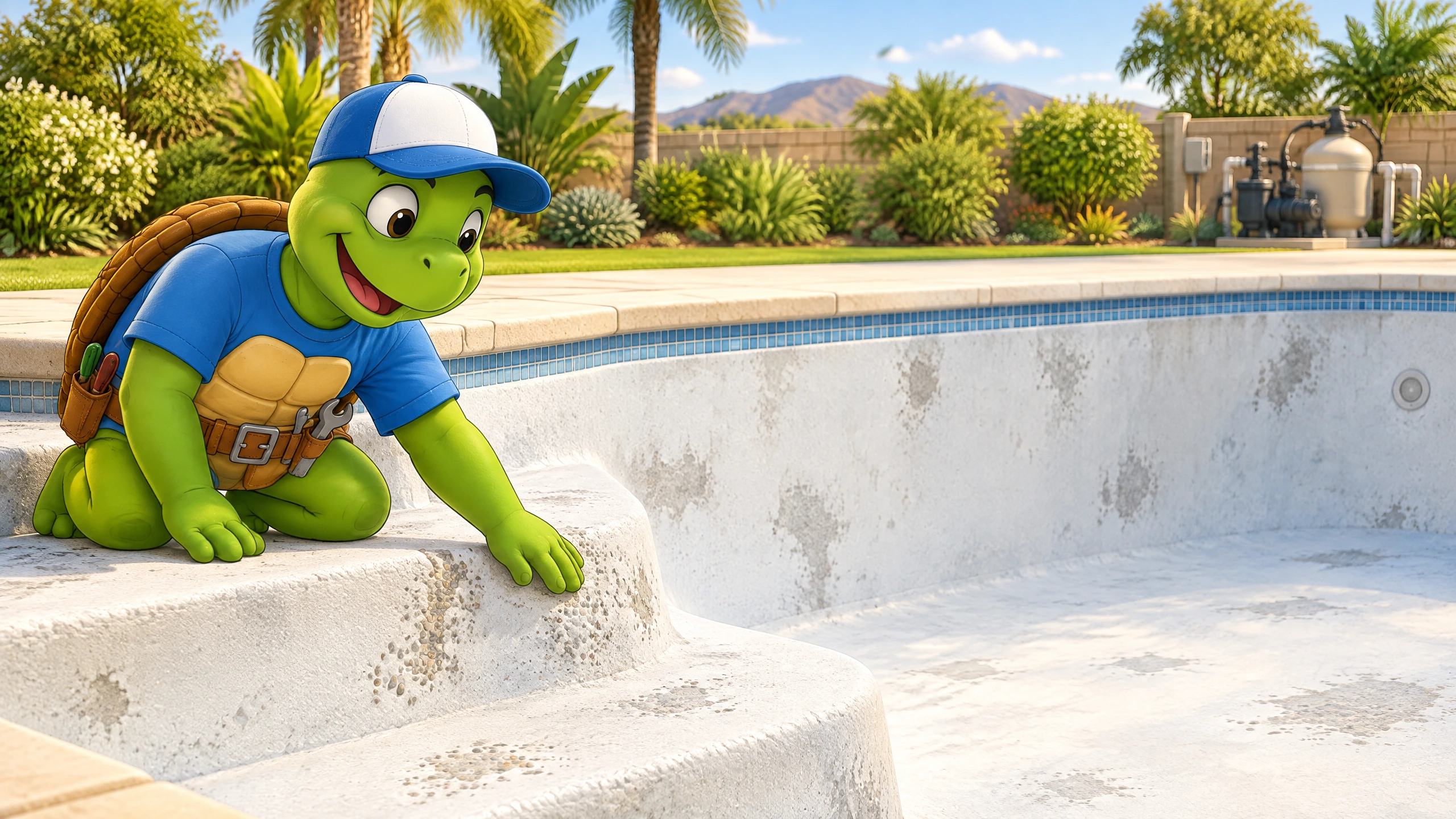
How Many Years Before a Pool Needs Resurfacing, And What It Costs Here
The trigger isn’t age. It’s the condition of the surface.
Years, White Plaster
Years, Colored Quartz
Years, Pebble
National Resurfacing Range
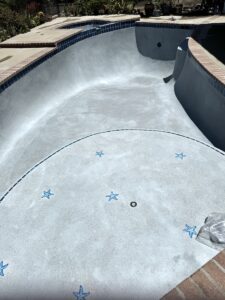
You notice it with your feet first. The step down into the shallow end feels like dry sidewalk, and the patch under the handrail feels like 60 grit sandpaper. There’s a gray blotch spreading from the main drain that you’ve brushed three Saturdays running and it hasn’t moved.
Before you price anything, get someone who does pool repairs and upgrades to put a hand on the surface. Nobody looks up pool resurfacing cost on purpose. You get there sideways, through your feet. Some of what you’re feeling is a finish at the end of its life. Some is a finish that needs a hard reset, and the gap between those two answers is several thousand dollars.
Most white plaster lasts 7 to 12 years, colored quartz 10 to 15, pebble 15 to 20 or more. Resurfacing a 1,000 square foot pool runs about $6,000 to $15,000 nationally. Expect the top of that range here. The trigger isn’t age. It’s the condition of the surface.
The calendar is not the trigger, the surface is
Plenty of 12 year old plaster is fine. Some 8 year old plaster is finished.
The difference is almost never the installer and almost always what the water did to it for those years, which is a question of pH, alkalinity and calcium hardness and nothing else.
What actually tells you it’s time:
- The surface feels sharp, not just textured. Rough is normal on aggregate. Sharp enough to scrape a knee on the steps is not.
- Exposed aggregate or gray substrate across broad areas, not one spot.
- Stains that survive a proper acid wash.
- Hollow-sounding spots, or plaster flaking off in coin-sized pieces. That’s delamination, and it doesn’t improve.
- Crazing opened into cracks you can catch a fingernail in.
What doesn’t count: one rough patch, or the fact that your neighbor just did theirs. A single dark patch usually isn’t the finish either, and brown water and staining after rain is the common version of that.
How long each finish lasts
The published ranges disagree, because the spread comes from chemistry more than from the product.
White plaster and marcite. HomeGuide’s 2026 cost guide puts standard plaster at 7 to 12 years. SGM, which manufactures pool finishes, says 5 to 10 with significant wear by the 5 to 7 year mark. In practice a well maintained plaster pool here gets 10 to 12 and a neglected one gets 6.
Colored quartz. Quartz doesn’t dissolve, so the surface holds up longer. SGM says 12 to 18 years, HomeGuide 10 to 15. Call it 12 to 15 on a pool that gets looked after.
Pebble aggregate. The long play. SGM and HomeGuide both land on 15 to 20 plus, and Pebble Technology says over 20 years with proper chemistry. The catch is that pebble is rougher underfoot from day one.
Is pebble worth the premium? Staying 15 years, yes, the cost per year is better. Selling in three, no.
Fiberglass and epoxy coatings. Epoxy pool paint runs about 5 to 10 years per ecoFINISH Coatings, and that’s the optimistic end of paint.
Should I just paint it? Paint on a gunite pool is a two to five year answer that makes the next real resurface harder. Skip it.
The 2026 numbers, and who published them
Pricing goes by interior surface area, not gallons. A 16 by 32 pool at five and a half feet average depth is roughly 1,000 square feet of floor plus walls, which is why cost guides use it as the example. HomeGuide’s 2026 figures:
| Finish | Per sq ft | 1,000 sq ft pool | Source |
|---|---|---|---|
| White plaster / marcite | $6 to $8 | $6,000 to $8,000 | HomeGuide 2026 |
| Quartz plaster | $7 to $10 | $7,000 to $10,000 | HomeGuide 2026 |
| Pebble | $7 to $15 | $7,000 to $15,000 | HomeGuide 2026 |
| Thermal polymer | $10 to $15 | $10,000 to $15,000 | HomeGuide 2026 |
Angi’s 2026 data puts the average job at about $11,000 for that same pool, range $6,000 to $15,000, labor $45 to $65 an hour.
Those are national pool resurfacing cost figures. Coastal California labor sits above national averages, so assume the upper half of every range. And the finish is only part of the bill.
The parts of pool resurfacing cost that aren’t the finish
The drain. The water comes out first, and that is the same draining and acid washing work we sell on its own. HomeGuide puts drain and clean at $600 to $650, refill at $400 to $2,000 if you buy delivered water instead of running a hose. An empty shell over a high water table can lift, so whoever drains your pool should know where the hydrostatic relief valve is.
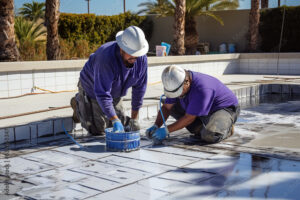
Chip out versus bond coat. This line decides whether the job lasts. A full chip out takes the old finish down to the gunite, loud and expensive, and it’s the right call when the plaster is already delaminating. A bond coat is an adhesive layer (SGM’s BondKote is the common one) that lets new plaster go over old, cheaper and faster. Bond coats work when they are used and cured properly. Plaster laid straight over old plaster with none at all is a known delamination risk.
If a bid quotes plaster over plaster and never says bond coat, ask.
Tile and coping. Waterline tile is its own line, usually a few thousand dollars, and it’s the one upsell worth taking if your tile is already scaled or loose, because the pool gets drained exactly once. Coping is bigger again and ties into the deck. If the tile looks chalky rather than broken, that is scale, not damage.
Do I have to do the tile too? No, but if it’s loose or heavily scaled, doing it while the pool is empty beats paying for a second drain later.
Plumbing. With the water out, a crew can see the main drain, the returns and the skimmer throat. Swapping a bad drain cover or a cracked return fitting now costs a fraction of later, and if the pool has been losing water, an empty shell is the best look anyone will get at finding and fixing the leak.
Startup. Some contractors include the 28 day startup. Some hand you a bag of chemicals and a brush.
Hard water, aggressive water, and the calcium problem
Two opposite failures kill plaster, and both are chemistry.
Aggressive water is the fast one. The Langelier Saturation Index measures how saturated water is with calcium carbonate, and Orenda Technologies puts the safe band at minus 0.30 to plus 0.30. Below minus 0.31 the water pulls calcium from whatever source is handiest, which in your pool is the cement holding the plaster together. SGM says pH below 7.0 etches cement-based finishes rapidly. Nobody etches a pool in a weekend. They do it by running pH at 7.0 with calcium hardness at 150 ppm for two summers, then wonder why a six year old finish feels like a driveway.
Scale is the slow one, and it’s the local one. California American Water reports total hardness around 140 mg/L for the Thousand Oaks and Newbury Park system, about 8.2 grains per gallon, ranging to 164. Hard, not extreme. The problem is not the fill water, it is what we do with it. Pools here run year round with no winter shutdown, evaporation is relentless, and every inch you top off adds calcium that nothing takes back out. Hardness climbs for years, and you get waterline scale, a gritty surface, and scale-forming water every August.
The fix is partial drains, not more acid.
Does saltwater ruin plaster faster? Salt itself doesn’t etch plaster. Salt systems drive pH up, and chasing that pH with acid does.
An acid wash buys years, and sometimes it’s the honest answer
If the plaster is stained but structurally sound, an acid wash is the right spend. Drain, acid wash to take off a thin layer and expose clean material underneath, rinse, refill, balance. That buys years on a sound surface, for a fraction of resurfacing money, but it is not a recurring service. Spending five figures when a wash would have done it is a waste. Timing helps too, and our notes on acid washing in winter to be ready for spring explain why we would rather do it in January.
The limit is thickness. Plaster goes on around three eighths to half an inch, and every wash takes some of the dense troweled skin off the top. A surface realistically gets one wash, maybe two, in its whole life.
If a company says yours needs one every three years, something upstream is broken and the wash is treating the symptom.
The first 30 days decide how long the new surface lasts
New plaster is still curing when you refill, and startup either sets it up for 12 years or costs you three. The Pool and Hot Tub Alliance publishes the fresh fill start-up procedure for plastered pools, adapted from National Plasterers Council guidance, and it is specific:
- Test the fill water first, then fill fast without stopping.
- No chlorine for 48 hours.
- Filtration runs continuously for seven days, or until the plaster dust is gone and the water is clear, with 72 hours as the absolute minimum.
- Brush the whole surface at least twice a day through day 7 to clear plaster dust.
- pH 7.2 to 7.6 and total alkalinity 80 to 100 ppm, adjusted daily through day 7.
- Calcium hardness from 80 to 100 ppm up to a 200 ppm minimum by day 4, in small increments hours apart.
- No salt for at least 30 days on a saltwater pool.
- No wheeled cleaner until after day 28. Brush vacuums are fine.
- No heater until the plaster dust is gone, and nobody in the water until it’s balanced and sanitized.
Daily attention for a week, close attention for a month.
If the contractor isn’t doing it, somebody has to, which is why plenty of resurfaced pools go onto weekly service the day they refill.
How long is the pool out of service? A week to ten days of work, then 28 days of startup where it’s swimmable but on a tight chemistry schedule.
Go feel the surface first
Get in and feel the whole surface with your hands, not just the steps. Note where it’s sharp, where aggregate shows, and whether anything sounds hollow. Then have someone look in person, because a rough patch and a dying finish look identical in a photo, and pool resurfacing cost swings by thousands on that one distinction.
Book a surface check
We are on about 175 pools a week, so we see a lot of finishes at both ends of their life. What we won’t do is price restoration work over the phone, because that number comes off the plaster itself and nothing else.
We look at the pool before we quote it.
Primary Pool Services – Ventura County
Thousand Oaks · Westlake Village · Agoura Hills · Camarillo · Newbury Park · Simi Valley · Moorpark · Ventura · Oxnard
Story produced with The Final Code.