Green Pool? Here’s What Actual Algae Removal Involves
Not a chemistry adjustment, but a multi-day job with a lot of brushing in it.
CDC Min With CYA
Ideal Cyanuric Acid
Breakpoint Multiplier
Pre-Shock pH Target
Free chlorine hit zero on Thursday. Nobody tested it, the water sat in the mid eighties, and by Monday you could not see the third step.
Nothing exotic happened in between. A few thousand algae cells got three warm days with no oxidizer in them, which is the whole argument for steady weekly service: a chlorine residual is the only thing standing between a clear pool and a week of this. Past that point, pool algae removal isn’t a chemistry adjustment, it’s a multi-day job with a lot of brushing in it.
Algae removal means correcting pH and alkalinity first, then holding a shock level of free chlorine calculated against your pool’s real volume and its cyanuric acid reading, brushing every surface daily, running the filter around the clock, and cleaning that filter repeatedly as it loads. Chlorine kills the algae. The filter removes it.
The three kinds you will meet
Green algae is free-floating, fast, and the only one that colors the whole body of water. It’s also the easiest to kill: no protective structure, dead at shock level in hours. A green pool still takes days to clear because dead algae is suspended solid, a filtration problem. For causes rather than cure, see what actually turns a pool green.
Mustard or yellow algae is yellow-brown powder on the shady wall. It brushes off in a cloud, looks gone, and is back in the same spot two days later. It tolerates chlorine at normal service levels, which is why it turns up in pools that test fine.
It lives on brushes, vacuum heads, floats and swimsuits too, so soak the gear in chlorinated water or you’ll reinfect the wall with your own equipment. Worth adding to what a weekly service visit covers for a month after an outbreak.
Black algae isn’t algae. It’s cyanobacteria, bacteria that grow slowly and compensate by armoring themselves. As AQUA Magazine’s technical write-up puts it, the colonies secrete a sticky gel that glues them down and forms “a protective barrier that prevents chlorine and other oxidizers from fully penetrating the algae colony.”
So it ignores shock. You aren’t treating a cell, you’re treating a fortified spot with a cap on it. It roots into rough plaster and grout lines, so it favors older gunite and dead-circulation corners. Breaking that cap with a stainless brush and putting chlorine straight onto the colony is the only thing that works, and if the plaster holds spores in pits you’ll fight it until the surface gets redone.
Pool algae removal is an order of operations, not a volume of chemicals
Fix pH and alkalinity before you shock
Chlorine splits into hypochlorous acid, which does the killing, and hypochlorite ion, which is far weaker. The split depends on pH. Near 7.2, roughly two thirds of your free chlorine is the active form. At 7.5 it’s about half. At 8.0 you’re near a quarter, so three quarters of what you bought does almost nothing.
A neglected pool is often at 8.2 with alkalinity in the 150s.
Shocking that water is expensive theatre.
Get pH to 7.2 to 7.4 and alkalinity into the 80 to 120 range first, which means muriatic acid and a few hours of circulation. The relationship between pH, alkalinity and chlorine is worth ten minutes before you spend a dollar.
Dose against the pool, not against the bag
Volume first. Length times width times average depth times 7.5 gets you close on a rectangle. A 15 by 30 averaging 5.5 feet deep is about 18,500 gallons, not the “around 15,000” most people guess.
A gallon of 12.5% liquid chlorine raises 10,000 gallons about 12.5 ppm, so in a 15,000 gallon pool, about 8 ppm. A pound of 73% cal hypo raises 10,000 gallons about 8.7 ppm.
One bag of shock is a unit of packaging, not a unit of chemistry.
Breakpoint chlorination is a different target: per the Indiana Department of Health’s shock guidance, operators are taught to dose ten times the combined chlorine reading. Algae needs a shock level held for days instead, set by your cyanuric acid.
Brush, then brush again
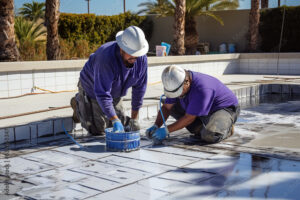
The step people skip, because it’s the only part that’s work. Walls, floor, steps, behind the ladder, the corner the returns miss. Brushing moves algae into the water where chlorine and the filter can get at it. Shock a pool without brushing it and it clears from the middle out, keeping a green ring on the walls.
Run the filter continuously, and clean it more than you’d like
Residential pumps are sized for roughly an eight to twelve hour turnover at full speed. During a recovery, run it 24 hours a day, no schedule, no off-peak savings. Yes, that costs real money on Edison’s time-of-use rates. Less than a second week of chemicals.
Then clean the filter repeatedly as dead algae loads it. Sand and DE get backwashed when pressure climbs eight to ten psi over clean baseline, in a bad pool twice a day. Cartridges come out, and there is a right way to do a full cartridge cleaning, and rinsing the outside is not it. Old channeled media won’t clear this pool.
Floc or vacuum to waste at the end, not the start
When the water turns from green to gray-cloudy, either let the filter finish or speed it up.
Flocculant drops the fines to the floor and you vacuum the pile to waste. It must never reach filter media, so it is for sand and DE with a multiport or slide valve, and a mistake on a cartridge with no bypass.
Cyanuric acid is why the pool won’t clear
Cyanuric acid is chlorine’s sunscreen. It binds most of your free chlorine into a reservoir UV can’t burn off, releasing a little at a time. Useful in an uncovered Thousand Oaks pool in July, and a trap, because bound chlorine isn’t working right now.
The equilibrium figures are stark. At a cyanuric acid to free chlorine ratio of 20 to 1, active hypochlorous acid sits around 0.02 ppm. At the shock ratio of 2.5 to 1, about 0.3 ppm. With no cyanuric acid, at CDC’s guideline, roughly 1.45 ppm. So 4 ppm free chlorine at 80 ppm cyanuric acid is doing less work than a single ppm would with no stabilizer in the water at all. That’s why CDC recommends at least 1 ppm free chlorine without cyanuric acid but 2 ppm with it, and why the industry association PHTA puts the ideal range at 30 to 50 ppm and caps it at 100.
The loop is self-sealing. Trichlor tablets deliver chlorine and stabilizer together: per CPO training material, every 10 ppm of chlorine from trichlor adds about 6 ppm of cyanuric acid, and dichlor adds about 9. Nothing consumes it. It doesn’t evaporate or burn off, it only leaves with water. Two seasons of tabs in the floater puts a pool at 150 ppm, where the shock target is past 50 ppm free chlorine. Almost nobody gets there, so the pool gets dosed, stays green, gets dosed again, and the owner decides the chlorine was bad.
Phosphates, honestly
Phosphate is algae food. True: fill water, leaves, fertilizer runoff and phosphonate-based sequestrants all add it. What’s oversold is phosphate remover as a green pool treatment. It kills nothing. A pool at 2,000 ppb with a correct chlorine residual stays clear, and lanthanum-based remover in water that is cloudy rather than green just adds a white precipitate your filter has to catch. It earns its keep on a pool with good chemistry that keeps sprouting mustard algae in one corner, after the water clears. Not during.
When is a drain cheaper than chemicals?
Chemistry has a break-even point. Past it, a drain and refill is faster and cheaper. You’re probably past it if the pool has been green for weeks, there’s sediment on the floor, cyanuric acid is over 100, or the plaster is stained under the algae. Holding 20 to 40 ppm of free chlorine against that much demand for a week costs more than the water, and still leaves stained plaster.
That’s the case for a drain and acid wash: empty it, take off a thin layer of plaster to expose clean material, rinse, refill, balance. It’s the only thing that reliably removes algae staining, and not a thing you repeat casually, because every wash takes a little plaster with it.
One wrinkle before anyone pulls a plug: the City of Ventura’s draining rules require chlorine below 0.1 mg/L and pH between 6.5 and 8.5 before pool water reaches the storm drain, and the city asks you to file its storm drain form first.
Shock-level water can’t legally go down the gutter.
How long does a green pool take to clear?
With correct cyanuric acid, a clean filter and someone actually holding the chlorine level, a light to moderate green pool clears in two to four days. Most of pool algae removal is filtration, not killing.
With a dirty or undersized filter, a week or more, and sometimes never, because the media passes fines straight back.
Should you swim in it?
No, and not for aesthetic reasons. Chlorine busy oxidizing algae isn’t available to kill pathogens, and you can’t see a hazard or a struggling swimmer through opaque water. CDC’s guidance on preventing swimming-related illness gives the test in a line: “Look for the drain. Make sure you can see the drain at the bottom of the deep end.” If you can’t find it, the water isn’t ready.
Things people ask once the water clears
Does algaecide replace chlorine? No. Polyquat helps prevent regrowth and helps with mustard algae, but pool algae removal still comes down to chlorine and filtration.
Why did it come back in a week? Free chlorine fell below what your cyanuric acid demands, the filter never got cleaned afterwards, or algae survived on equipment.
Do salt pools get algae? Yes. A cell has an output ceiling and can’t outrun a bloom, and salt pools run higher cyanuric acid, raising the chlorine target.
Test before you buy anything
Test cyanuric acid and pH before a single bag comes off the shelf. If it’s over 100, or there’s sediment on the floor, stop buying chemicals, because the answer is water.
Then get us on the phone at (805) 586-2055 with those two numbers in front of you. If it’s a two-day recovery we’ll say so. If it’s a drain, we’ll say that too. What we won’t do is put a price on a green pool over the phone, because the surface, the filter and your cyanuric acid reading decide the job, and all three have to be seen.
Two-day recovery, or time for a drain?
Call with your cyanuric acid and pH readings in front of you and we’ll tell you which one it is. The surface, the filter and that cyanuric acid reading decide the job, and all three have to be seen.
We look at the pool before we quote it.
Primary Pool Services – Ventura County
Thousand Oaks · Westlake Village · Agoura Hills · Camarillo · Newbury Park · Simi Valley · Moorpark · Ventura · Oxnard
Story produced with The Final Code.