Test Strips, Drop Kits or a Pro: How Pool Water Testing Actually Works
What each pool water testing method can and can’t tell you, and why the cheap one is usually the vague one.
Per Drop in a FAS-DPD Test
Minimum Reagent Shelf Life
Safe Reagent Storage Range
Hardness in Local Imported Water
You dip the strip, wait the few seconds the bottle asks for, and hold it up to the chart. The chlorine pad is somewhere between “a little pink” and “slightly more pink.” Two color blocks both sort of match. You split the difference, call it fine, and go back inside.
That’s pool water testing for a lot of homeowners, and it’s not entirely wrong. It’s just not very precise. If you test your own water, or a weekly tech does it for you as on our Newbury Park pool service routes, the method decides how much you can trust the number.
Test strips are fast and fine for a quick check, but they’re color matches with wide gaps and are the least accurate option. Drop kits, especially FAS-DPD kits for chlorine, count drops instead of guessing at colors and can read chlorine to 0.2 ppm. Taylor rates its reagents for at least a year and says to replace them each pool season, and heat breaks them down faster. For most homes, a good drop kit or a weekly service that tests and reports every visit gives you numbers you can actually act on.
What pool water testing is actually measuring
Five readings do most of the work in a residential pool, plus salt if you have a salt system. Raypak, which builds pool heaters, publishes target ranges on its water chemistry page because bad water is hard on its equipment.
| Reading | What it tells you | Raypak’s range (non-fiberglass pools) |
|---|---|---|
| Free chlorine | Sanitizer that’s available to work | 2 to 3 ppm, never above 5 |
| pH | Acid or base, affects comfort and chlorine strength | 7.6 to 7.8 |
| Total alkalinity | How well pH holds steady | 80 to 120 ppm |
| Calcium hardness | Scaling or etching tendency | 200 to 400 ppm |
| Salt (salt pools) | Fuel for the salt cell | 4,500 ppm maximum |
Cyanuric acid, the stabilizer, is the fifth reading. Raypak doesn’t list a range for it, but the Oregon Health Authority puts the ideal at 30 to 50 ppm. It matters because it changes how much chlorine the pool needs.
How test strips work, and where they fall short
A strip is a set of chemical pads that change color. You compare them to a printed chart. That’s it.
The problem is the comparison. The color blocks on the bottle have gaps between them, lighting changes what you see, and a strip that’s been in a humid cabinet reads differently from a fresh one. The Oregon Health Authority’s test kit bulletin says dip strips “have been shown to be very difficult to accurately read” and doesn’t accept non-DPD strips for required testing at public pools. Operators can still use them for quick checks between real tests.
That’s the right way to think about strips at home too. They’re a smoke detector, not a diagnosis.
A strip can tell you the chlorine is low. It has a much harder time telling you how low.
Drop kits: DPD, FAS-DPD and the yellow ones
Liquid drop kits come in a few types, and the chlorine test is where they differ most.
OTO kits turn yellow. San Bernardino County’s environmental health FAQ says these “OTO” kits are difficult to use for accurately determining free chlorine, and recommends DPD tablets or liquid instead.
DPD color kits turn pink and you match the shade to a comparator. Better, but still a color match.
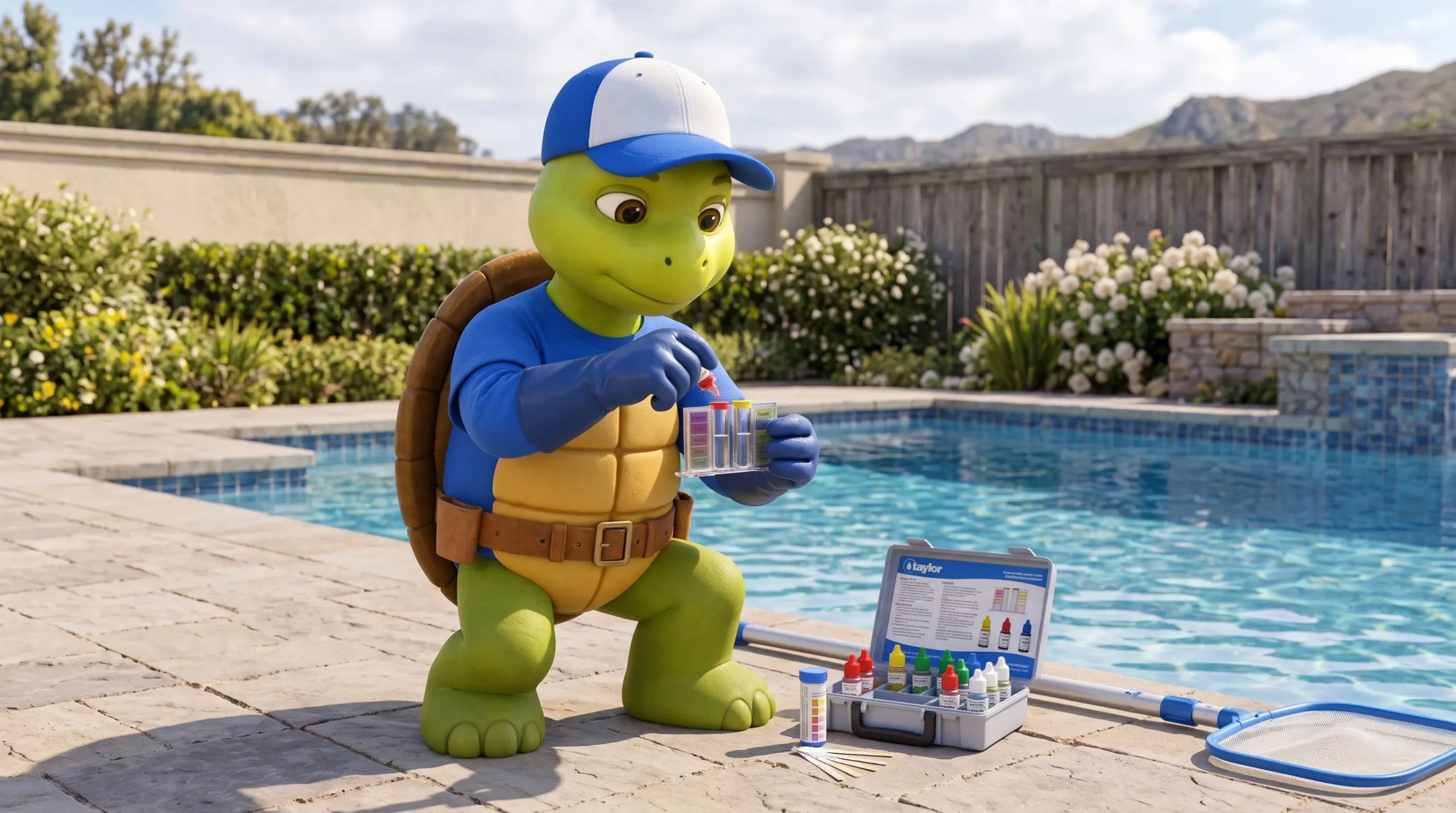
FAS-DPD kits turn the sample pink, then you add a titrating reagent one drop at a time until it goes clear and count the drops. Taylor’s instructions give the math: with a 25 mL sample, each drop equals 0.2 ppm, and with a 10 mL sample, each drop equals 0.5 ppm. No color judgment, which is why Oregon suggests the Taylor K-2006 FAS-DPD kit as the basic standard for its pool inspectors.
Count, don’t guess. If you’re buying one kit for your own pool, get one with a FAS-DPD chlorine test. Counting drops to the color change is the same method inspectors trust, and it doesn’t depend on your eyes or the light.
Your reagents have an expiration date
Drop kits only work if the reagents are good. Taylor says its reagents are formulated to stay effective for at least one year and recommends replacing them at the start of each pool season.
Storage matters even more. Taylor’s guidance is to keep reagents between 36°F and 85°F, out of direct sun. A kit stored in the equipment box at a pool in Moorpark or Simi Valley is going to blow past 85°F for most of the summer.
Taylor also lists the warning signs. The FAS-DPD titrating reagent should be colorless and turns yellow as it degrades. The phenol red pH indicator shifts to yellow or purple. Calcium hardness indicator should be deep blue. If a bottle looks wrong, the reading will be too.
What about pool store water testing?
A pool store test is a useful second opinion, especially for numbers home kits don’t cover well. It’s still a single snapshot of a sample that rode around in a car.
Take the sample from elbow depth, away from the returns and the skimmer, and bring it in quickly. And keep in mind the person running it may also be the person suggesting what to buy. That’s not a scandal, just a reason to know your own numbers first.
Local water starts out hard
Water providers around Thousand Oaks buy imported water from Calleguas Municipal Water District, which is why the City of Thousand Oaks passes Calleguas cost increases through on its rates. Calleguas’s 2025 water quality report lists its main imported supply at an average total hardness of 140 ppm, a pH of 8.3 and alkalinity around 98 ppm.
Water evaporates and the minerals stay behind, so topping off all summer slowly pushes hardness up. Calcium shows up first as a white line at the waterline, which is what our post on removing calcium deposits from pool tile deals with. Testing calcium hardness a few times a year tells you if you’re heading there.
How often should you test?
Chlorine and pH change the fastest, so they get tested the most, at least weekly and more during heat waves or heavy use. Alkalinity moves slower. Calcium hardness and stabilizer can be checked monthly.
Salt pools add a salt reading, since a salt cell needs the right level to produce chlorine. If the cell reports low salt but your test says otherwise, our post on when to check and clean a salt cell is the next stop.
When stabilizer or dissolved solids climb too high, testing tells you the problem but chemicals can’t fix it. That’s when the answer is a partial drain, covered in how often a pool should actually be drained.
What a weekly service tests, and how you see it
On our routes, the tech tests the water each visit and adjusts from the readings. After every visit you get an email report with photos and the water readings, so the numbers aren’t a mystery and you can see a trend instead of a single moment.
That history is the real value. One reading of 1.5 ppm chlorine means little. The same reading three weeks running after the pool sat at 3 tells you something changed. It’s covered in more detail on our monthly maintenance service page.
Asked at the pad, every week
Are digital testers better than strips? Some electronic readers are accepted for public pool testing in Oregon’s bulletin. The quality varies a lot by device, so check what method it uses.
Why do my strip and my kit disagree? Usually the strip. It’s reading a color range, and the kit is counting drops. If the kit’s reagents are fresh, trust the kit.
Do I need to test if I have a weekly service? Not necessarily. A quick strip between visits during a heat wave or after a party is still a smart habit.
I just bought a house with a pool. Where do I start? A full test on day one gives you a baseline. Our first 30 days with a new pool guide covers the rest.
Want real numbers every week?
Send us your latest readings, or tell us what test you’re using, and we’ll tell you what they mean and what we’d change. You can reach us through our contact page.
We service Pentair, Jandy, Zodiac, Hayward and Sta-Rite equipment, or call (805) 586-2055.
Tired of squinting at test strips?
Weekly service means your water is tested every visit and the readings land in your inbox. You see the trend, not just a color.
“Kind of pink” is not a reading.
Primary Pool Services – Ventura County
Thousand Oaks · Westlake Village · Agoura Hills · Camarillo · Newbury Park · Simi Valley · Moorpark · Ventura · Oxnard
Story produced with The Final Code.