How Do You Remove Hard Calcium Deposits From Pool Tile?
One drop of acid decides whether you’re buying a $12 pumice stone or booking a crew with a blasting rig.
Local Total Hardness
Grains Per Gallon
Gas Heater Ceiling
Per Linear Foot
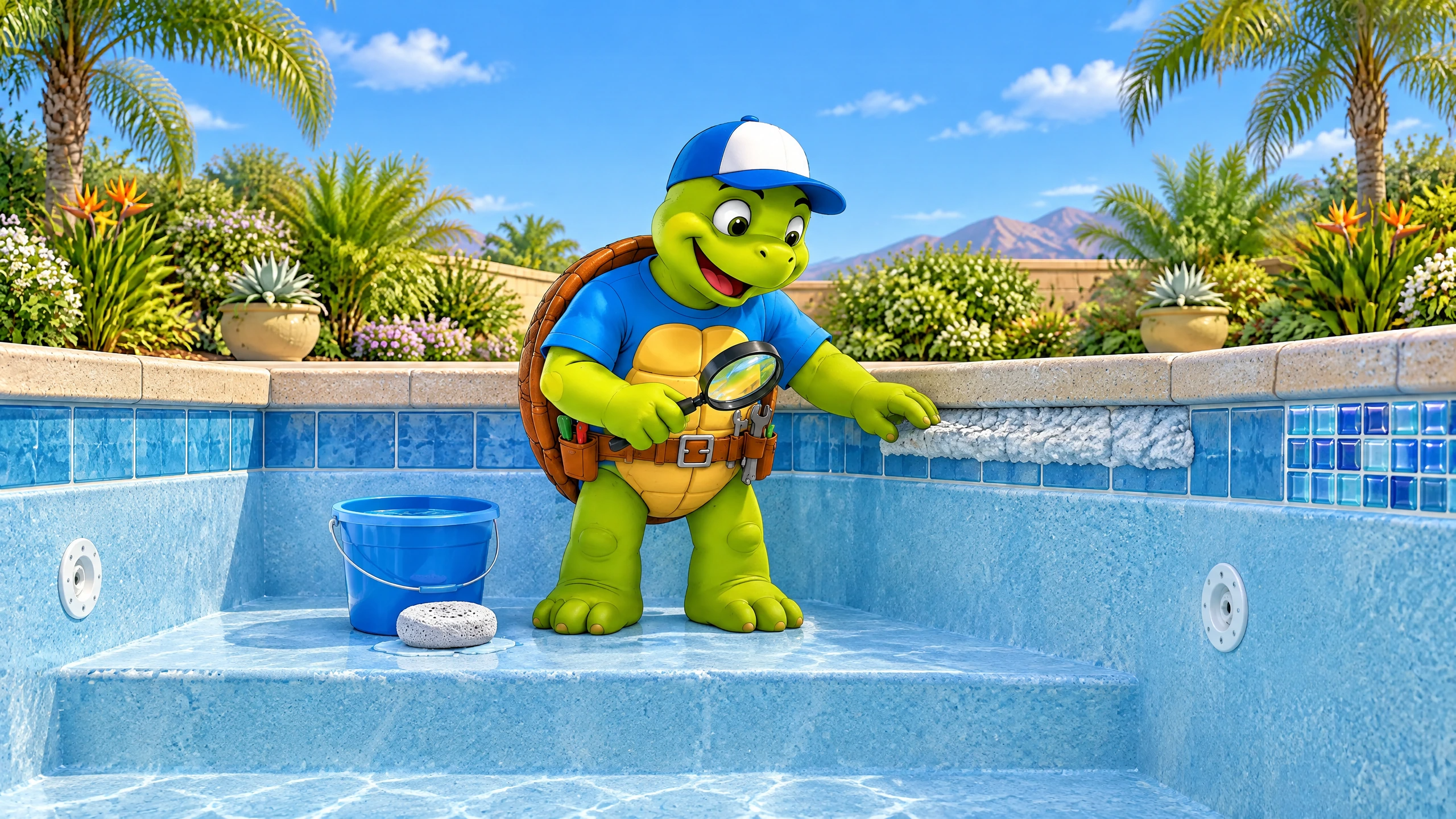
The crust at the waterline sits about a sixteenth of an inch proud of the tile. Run a thumbnail across it and it catches, the way dried grout catches, and it doesn’t powder or flake away. You’ve been brushing that band for months without taking any of it off. By then a drain and acid wash is closer to the real conversation than another bottle of cleaner, especially if the plaster under the tile has gone rough too. Calcium removal on pool tile stops being a brushing problem at that point.
The bottle that most calcium removal pool tile searches lead to is usually aimed at the wrong deposit. Some of the crust is chalky white, some closer to gray, and it follows the water level in a band two or three inches tall around the pool.
Goggles and gloves on, then put one drop of muriatic acid on a dry patch of the crust. If it fizzes, it’s calcium carbonate, and a pumice stone or an acid-based tile cleaner will take it off. If it just sits there, it’s calcium silicate, which acid won’t touch. That one needs mechanical removal, usually professional bead blasting.
The two kinds of calcium look alike and behave nothing alike
They are different minerals, and only one of them cares about acid.
Calcium carbonate is the common one. Pool builder Latham describes it as white and flaky, which is accurate. It forms fast, often within a season of the water drifting out of balance, and it crumbles at the edges under a fingernail. It’s the deposit you can usually beat yourself, and the one weekly service keeps ahead of, because catching the drift is easier than catching the crust.
Calcium silicate is the one that eats weekends. Latham calls it white-gray and much harder to move, and it takes years to form rather than months. When it shows up on tile there’s usually matching scale in the plumbing and at the heater, which turns it into equipment repair work rather than a tile job. Orenda Technologies, whose water chemistry work drives a lot of the industry’s LSI thinking, says silicate scale often looks rounded, almost like grains of rice, and is essentially immune to muriatic acid. Back the drop test up with a screwdriver tip: carbonate scrapes to powder, silicate skates and the metal squeals.
Calcium removal on pool tile, least aggressive method to most
- Pumice stone. A pumice block and a bucket of pool water, worked wet, takes carbonate off plaster and off hard glazed ceramic. Slow, cheap, effective. Keep stone and surface soaking wet, because dry pumice grinds instead of abrading and leaves swirls. It’s a bad idea on glass tile, on polished or iridescent tile, and on travertine coping. National Pool Tile, which makes the stuff, tells people to avoid pumice stones and 50/50 brushes on tile.
- Acid-based tile cleaner. Works on carbonate, works fast, carries two real risks. Anything containing hydrofluoric acid attacks tile glaze and iridescent glass permanently, which NPT flags along with the neutralizing mix if you spill (baking soda and water, one pound to three gallons). And acid dissolves cementitious grout right along with the scale.
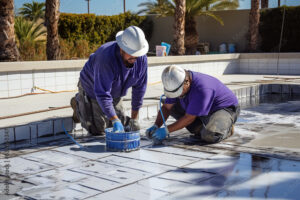
- Bead or glass bead blasting. The professional answer for silicate, and for carbonate too thick to hand-work. The water drops below the tile and a media stream strips the deposit. Media choice decides whether the tile survives: NPT says blasting with mild abrasives such as baking soda or kieserite is safe on all tile types including glass, which is why a crew carrying one grade of silica sand is wrong for a glass mosaic waterline. Blasting also scours grout, so on an older pool expect a regrout or seal conversation.
Do a whole waterline in strong acid and you clean the tile beautifully while quietly opening every grout joint, which is how tile starts falling off two years later. Spot use, rinsed properly, is fine. A wall-to-wall acid attack on old grout isn’t.
Why Ventura County water makes this so much worse
The fill water is the reason. Thousand Oaks and Newbury Park are supplied entirely with treated surface water bought from Calleguas Municipal Water District, and per California American Water’s 2025 annual water quality report for the Thousand Oaks system, total hardness runs about 140 mg/L, which the utility states as 8.2 grains per gallon. Depending on which plant feeds the system it ranges to 164 mg/L with delivered pH at 8.3 to 8.4 and alkalinity near 100 ppm. That is what comes out of the hose on every pool we service in Thousand Oaks.
Water evaporates. Calcium doesn’t.
Every gallon that leaves as vapor on a 95 degree Santa Ana afternoon leaves its minerals behind, and every gallon of hose water you add to replace it brings 8-plus grains of fresh hardness in. That’s the honest reason drain-and-refill is a maintenance item in Ventura County and not just a repair.
ANSI/APSP-11, the standard the Pool and Hot Tub Alliance publishes against, treats 150 to 1,000 ppm calcium hardness and a pH of 7.2 to 7.8 as acceptable. Then there are Orenda’s Langelier Saturation Index thresholds: above +0.30 the water is scale-forming, below -0.30 it’s aggressive and pulling calcium out of the plaster instead. LSI isn’t something you test; it’s calculated from calcium, alkalinity, pH, temperature and TDS together, which is why high hardness alone doesn’t doom you. If that’s unfamiliar ground, our primer on pH, chlorine and alkalinity covers it. A pool at 600 ppm calcium with alkalinity held low and pH at 7.4 can sit in range. The same pool at pH 8.1 scales the tile.
One exception. If you have a gas heater, its manual sets its own ceiling, usually 400 ppm, and running above it on an LSI argument will not help you with a warranty claim.
What a crew charges per linear foot
It scales with how bad the deposit is.
| Scale and method | What it runs | Source |
|---|---|---|
| Light scale, chemical or pumice | $3 to $6 per linear foot, practical minimum $250 to $500 | Cost reference site The Pricer |
| Moderate scale, glass bead or soda blasting | $6 to $8 per linear foot, practical minimum $400 to $850 | Cost reference site The Pricer |
| Heavy scale, salt or multiple media passes | $8 to $12 per linear foot, practical minimum $750 to $1,000 and up | Cost reference site The Pricer |
| Brush-and-rinse labor, not a calcium strip | $1.73 to $2.14 per linear foot | Homewyse’s January 2026 calculator |
The gap between the two is the difference between cleaning tile and removing scale.
We don’t quote scale work over the phone either, because a photo makes light carbonate and heavy silicate look identical.
When the DIY route is genuinely the right call
On light carbonate, do it yourself.
If the test fizzes, the band is thin, the tile is standard glazed ceramic and you have a Saturday, a pumice block and constant water contact gets you a clean waterline for the price of the stone.
That answer costs us the job. Take it anyway.
Where DIY stops being right: silicate of any thickness, glass or natural stone waterlines, more than about a quarter inch of buildup, grout that’s already soft or missing, or a pool where the tile is only part of the problem. A hard crust above plaster that’s visibly etched or rough underfoot isn’t a tile job, and cleaning the tile only makes the plaster look worse. That’s when it turns into a drain, and we’d rather run those in the cool months, which is the case we make in winter acid washing ahead of spring.
What keeps the waterline clean between services
Brushing won’t remove bonded scale, but it absolutely stops the next layer bonding. Wet, loose calcium wipes off. Calcium that sat six weeks doesn’t.
- Hold pH at 7.2 to 7.6 rather than letting it drift to 8. With fill water arriving at 8.3, climbing pH is the default condition here.
- Keep total alkalinity toward the low end. PHTA recommends running it low within the acceptable 60 to 180 ppm range to offset calcium buildup when water replacement is limited.
- Test calcium hardness a few times a year. Most homeowners have never measured it once.
- Replace water on a schedule. Partial drain-and-refill is the reset; a full drain and acid wash resets the baseline.
- Keep the routine consistent. Brushing the band every week beats a heroic scrub twice a year.
Will a pool store bottle remove calcium from tile?
Thin carbonate, sometimes. Silicate, never, whatever the label says. Do the drop test before you spend money on a bottle.
Can I use a pumice stone on glass tile?
No. National Pool Tile’s own care guidance says avoid pumice on tile, and glass and iridescent finishes haze permanently. Soft-media blasting is the safe route.
How long does professional tile cleaning take?
Most residential waterlines are one visit. Heavy silicate, or a tile clean combined with a drain and acid wash, runs longer.
Will the calcium come back?
If the chemistry that created it doesn’t change, yes. Hard fill water plus evaporation plus drifting pH rebuilds the band. That’s arithmetic, not a sales line.
Do the drop test this weekend
Two minutes, goggles, one drop of acid. It decides whether you’re buying a $12 pumice stone or booking a crew with a blasting rig.
If it comes back silicate, or the tile is glass or stone, or the plaster has gone rough underfoot, get eyes on it. A tech will tell you which method it needs, including when the honest answer is that you can handle it yourself. Deposit type and tile type both have to be seen, so the number comes after the visit.
Call (805) 586-2055 or send details through the contact page. We work the whole county, Thousand Oaks to Camarillo.
Not sure which deposit you have?
A photo makes light carbonate and heavy silicate look identical, so we don’t quote scale work over the phone. Deposit type and tile type both have to be seen first.
We look at the pool before we quote it.
Primary Pool Services – Ventura County
Thousand Oaks · Westlake Village · Agoura Hills · Camarillo · Newbury Park · Simi Valley · Moorpark · Ventura · Oxnard
Story produced with The Final Code.