What Are the New California Pool Laws in 2026?
Fewer than the internet says, and almost none of them touch the equipment you already own.
Solar Area For New Heated Pools
Safety Features On A Permit
Unlicensed Work Limit
Federal Heater Standard
The bid for a new pool is sitting on the equipment pad of the old one, held down by a chlorine float. It lists a 400,000 BTU gas heater, which was an ordinary line item two years ago. Under the California pool laws and codes that apply to permits filed since January 1, 2026, that heater can’t be the primary heat on a new pool anymore. We hear versions of this question at the pad while doing our pool services, and most of the answers online are wrong in the same direction: too dramatic.
Most of what gets sold as “new for 2026” is a 2025 change, a rule aimed at manufacturers, or a bill that never passed. A few things really did change. We only list what we could confirm on official sources, with the date each one took effect.
The biggest 2026 change to California pool laws is the 2025 Energy Code: a new pool or spa whose permit application went in on or after January 1, 2026 needs a heat pump, solar, or mostly renewable heat as its primary heater, and gas can only be the backup. The Swimming Pool Safety Act was tightened on January 1, 2025, and rules for new pump motors and pool controls kicked in during September 2025. None of these rules, as written, makes you replace working equipment on an existing pool.
This is general information, not legal advice. We are pool techs, not lawyers. Codes get amended and cities add their own rules, so confirm anything that matters with your building department or water supplier before you build, remodel or sign a contract.
California pool laws that changed, in one table
Everything we could verify for 2024 through 2026, oldest first. The last row is there because people keep asking about it.
| Law or rule | What it requires | Effective | Who it applies to |
|---|---|---|---|
| SB 552, Swimming Pool Safety Act | Tightens the 2 of 7 drowning prevention features and what home inspectors report | January 1, 2025 | Homeowners pulling a permit for a new pool or remodel, and home sales |
| AB 2622, contractor licensing | Raises unlicensed minor work limit from $500 to $1,000 | January 1, 2025 | Anyone hiring a handyman |
| Making Conservation a California Way of Life | Annual water use objectives | January 1, 2025 | Urban water suppliers, not households |
| Title 20 pool controls (flexible demand) | New controls default to running equipment when power is cheap and cleaner | Made on or after September 29, 2025 | Manufacturers, and you when you buy new |
| Federal pool pump motor standard | Variable speed for motors 0.5 hp and up | September 29, 2025 (1.15 to 5 hp), September 28, 2027 (0.5 to 1.15 hp) | Manufacturers |
| 2025 Energy Code, Section 110.4(c) | Heat pump, solar or 60% renewable as primary heat | Permits applied for on or after January 1, 2026 | New pools and spas |
| Federal pool heater standard | Higher gas heater efficiency, first rules for electric heaters | May 30, 2028 | Manufacturers |
| AB 1237 (condo pools) | Would have extended the Act to condominium units | Not law | Held in committee August 13, 2026 |
The 2026 change: heat pump or solar first on new pools
The California Energy Commission’s 2025 Energy Code page is blunt about timing: buildings whose permit applications are applied for on or after January 1, 2026 must comply. For pools, the part that matters is Section 110.4(c), the heating source sizing rule. You can read the code package on the California Energy Commission’s 2025 Energy Code page.
The code gives five ways to heat a new pool or spa:
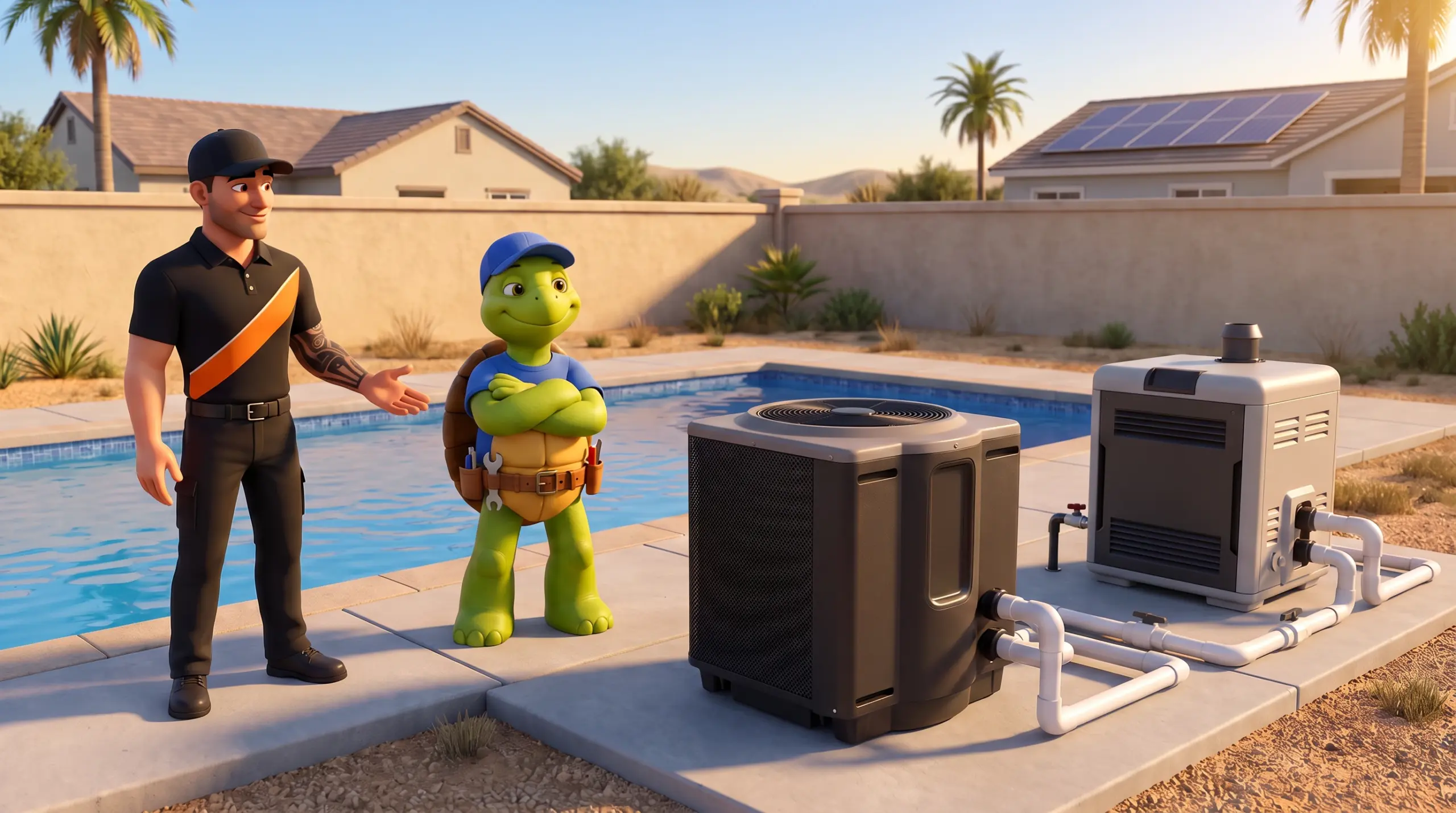
Solar, with collector area equal to at least 60% of the pool and spa surface area at a single family home (65% for multifamily and nonresidential). A heat pump as the primary heater, sized to the code’s Joint Appendix JA16.3, and the code text says “the supplementary heater can be of any energy source.” On-site renewable or recovered energy covering at least 60% of the annual heating. Solar plus a heat pump with no other heater. Or a system the Commission’s Executive Director finds uses no more energy than those.
Read that heat pump line twice. A gas heater is still allowed as the supplementary heater. The CEC’s summer 2025 Blueprint newsletter adds Section 110.4(d): heat pump controls have to keep the supplementary heater off when the heat pump alone can carry the load. So gas becomes the heater you use on cold April mornings, which is honestly the job it was best at anyway.
It isn’t a gas heater ban. It’s a gas heater demotion.
Section 110.4(b) still says outdoor pools and spas with electric or gas heating equipment “shall be installed with a pool cover.” Not new, but it’s the cheapest line in the section, and the one most often found folded behind the shed.
Does the new energy code make me replace my gas heater?
No. Exception 2 to Section 110.4(c) exempts “alterations to existing pools and/or spas with existing heating systems or equipment.” If your pool already has a heater and it dies, the replacement falls under that exception. The other exceptions cover portable electric spas, pools heated only by solar with no backup, and permanent spas in existing buildings with gas service or without enough solar roof area.
The gray area is adding a heater to a pool that has never had one. That pool has no existing heating system, so as we read it the exception doesn’t help, and your building department makes the call. Ask before the install, not after the inspector does.
If your heater is acting up now, the code doesn’t decide repair versus replace. Age and the failed part do, and we walked through that in whether a pool heater is worth fixing.
Pumps and pool controls: 2021, 2025 and 2027
California got to variable speed pumps first. The CEC’s replacement pool pump motor FAQ says motors rated 0.5 hp or more and manufactured on or after July 19, 2021 must be variable speed. We covered the details in the California variable speed pump rule.
The federal government caught up in 2025. DOE’s September 2023 final rule for pool pump motors requires variable speed control on motors 0.5 hp and up. Compliance started September 29, 2025 for motors from 1.15 to 5 hp, and it starts September 28, 2027 for motors from 0.5 up to 1.15 hp. DOE’s enforcement policy says it won’t seek penalties on those smaller motors made between September 28, 2027 and March 26, 2029. In California that breather changes very little, because the state rule already got there in 2021.
The newer one is about the timer. Under the CEC’s flexible demand standards, adopted October 18, 2023, new pool controls manufactured on or after September 29, 2025 have to default to running equipment when electricity prices and greenhouse gas emissions are low. The CEC says settings can be changed by users at any time, and the control needs your consent to send or receive signals. It estimates a customer on a time-of-use rate saves $1,131 over the life of the control.
Your old mechanical timer with the little pins isn’t illegal. It’s just old. On SCE time-of-use rates, when the pump runs matters as much as how long, which is the whole argument in whether to run the pump at night or during the day.
Federal pool heater standards land in 2028
DOE’s consumer pool heater rule was published May 30, 2023, and compliance is required on and after May 30, 2028. The Appliance Standards Awareness Project, which tracks these rules, says the new gas standard is based on a minimum 84% thermal efficiency, up from 82%. It also says the rule sets the first efficiency requirements for electric pool heaters and “effectively require[s] the use of efficient electric heat pump technology.”
The same group notes electric resistance pool heaters can use more than five times as much energy as heat pumps. If someone offers you a cheap resistance heater for a full size pool, the federal government has already weighed in, and so has your SCE bill.
The heater on your pad today stays legal until it quits.
The Swimming Pool Safety Act: SB 552, and a bill that didn’t pass
SB 552 (Chapter 769, approved September 27, 2024) took effect January 1, 2025. The core rule didn’t change: a permit for a new pool or spa, or a remodel, at a single family home still triggers at least 2 of 7 drowning prevention features. What changed is the fine print. Exit alarms now cover windows with direct pool access, not just doors. A pool alarm has to be in good repair and operable. Some pairs no longer count as two features, such as an exit alarm and a self-closing latch on the same door. And a home inspection at sale now has to identify which features are in good repair, operable and labeled. The fence and gate details are in our post on California pool fence law.
Now the one that didn’t happen. AB 1237 would have applied the 2 of 7 rule to condominium units and had the Building Standards Commission put the Act into the California Building Code by March 1, 2027. The Legislature’s own bill history shows it was held under submission in the Senate Appropriations Committee on August 13, 2026. That’s not law. We found no new pool safety statute that took effect January 1, 2026.
Water rules: less new than the headlines
The State Water Resources Control Board adopted “Making Conservation a California Way of Life” on July 3, 2024, effective January 1, 2025. Its own summary says urban retail water suppliers, “not individual households or businesses,” are held to the new water use objectives. So there is no statewide rule in it about filling or draining your pool. Your water supplier sets watering days and any emergency limits.
Draining rules are local and not new, and they vary more than people expect. The City of Ventura’s pool draining page allows discharge to the street once chlorine and bromine are below 0.1 mg/L and pH is between 6.5 and 8.5, needs no permit, and bans pool water in sewer cleanouts. It also says saltwater pools can’t be drained to the storm drain or the sewer, and filter wash water can’t leave your property. Thousand Oaks or Camarillo may say something different, so check your own city first. It’s one of the things we sort out before any pool draining and acid wash.
Salt pool owners, take note. Under Ventura’s rules, a salt pool can’t simply be pumped into the street. Plan the disposal before anyone drops a submersible pump in the deep end.
Hiring help: the $1,000 line
AB 2622 raised the limit for unlicensed “minor work” from $500 to $1,000 on January 1, 2025. The Contractors State License Board’s bulletin adds two conditions that matter more than the number: the job can’t require a permit, and the unlicensed person can’t employ anyone on it. Unlicensed workers can now advertise jobs up to $1,000 if the ad says they aren’t licensed.
Pool work runs past that fast. A new heater, a new circuit for a heat pump, or a replaster all blow through $1,000 and often need a permit. If you’re vetting someone, our guide on how to choose a pool service covers the questions to ask.
Questions about California pool laws we hear at the pad
Do I have to replace my single speed pump? No. The state and federal rules govern motors being manufactured. Your working pump stays legal. When it fails, the replacement motor will be variable speed.
Is gas pool heat banned in 2026? No. On new pools permitted since January 1, 2026, gas can’t be the primary heater, but it can be the backup. Replacing a heater on a pool that already has heat is exempt from the new sizing rule.
Did the fence rules change for 2026? Not that we could find. The last change was SB 552 on January 1, 2025, and it applies when you pull a permit or sell.
Can my city stop me from filling the pool? The state regulation targets water suppliers, not you. Local drought stages can restrict water use, so your supplier’s current rules are the ones to check.
Ask one question before you sign a pool bid
If you’re building, remodeling or adding heat in 2026, ask the contractor this: which Section 110.4(c) option does the heating plan use? A good builder answers in one sentence. A bid with a lone gas heater on a new pool, and no heat pump or solar, is a bid that hasn’t met the 2025 code yet.
For existing pools it’s simpler: keep what you have running, and replace failures with what the current rules require. Send us the details through the site: what failed, the brand and model off the data plate, and roughly how old it is.
We service Pentair, Jandy, Zodiac, Hayward and Sta-Rite equipment. Call (805) 586-2055 and we’ll get a tech out to the pad.
New rules, same equipment pad
Most of the 2025 and 2026 rules only reach your pool when something gets replaced. When that day comes, have the brand, model number and age of the failed part ready when you call.
Working equipment is legal equipment. Keep it working.
Primary Pool Services – Ventura County
Thousand Oaks · Westlake Village · Agoura Hills · Camarillo · Newbury Park · Simi Valley · Moorpark · Ventura · Oxnard
Story produced with The Final Code.