What Heavy Rain Does to Your Pool and What to Do the Day After
A morning-after plan for your pool after heavy rain: the equipment pad, the water level, the debris and the chemistry, in the order that matters.
Gallons Per Acre Per Inch of Rain
pH of Normal Rain, Per EPA
CDC pH Range for Pools
Wait After the Last Thunder
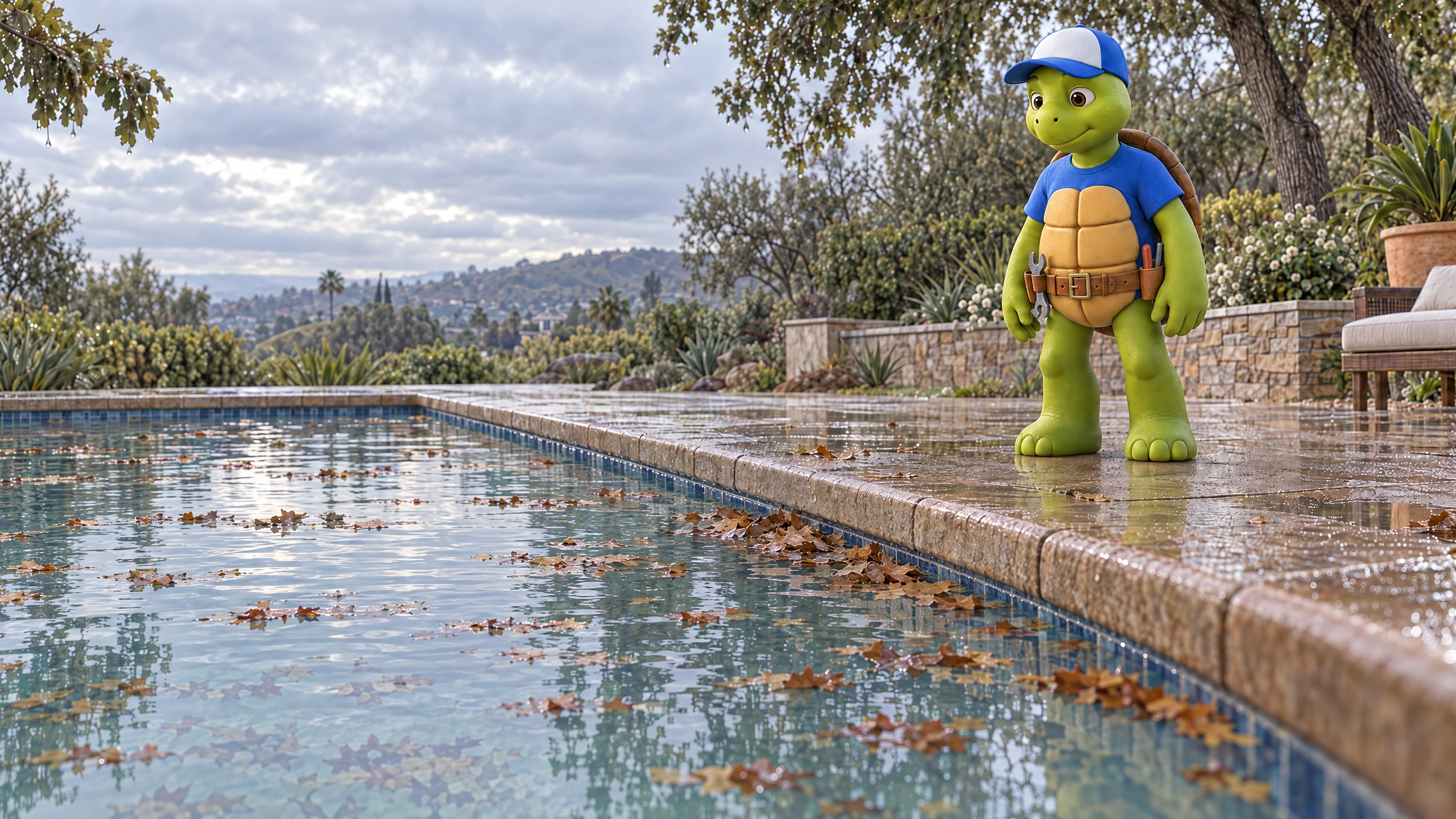
The storm rolled through overnight. In the morning the pool is a shade of tea, the water is lapping at the top of the tile, there’s a layer of oak leaves on the bottom and something that used to be a pool float is wedged against the skimmer. This is a normal winter morning in a lot of backyards, and handling a pool after heavy rain is mostly about doing things in the right order, which is how we approach it on our Thousand Oaks pool service routes and everywhere else.
Rain doesn’t usually wreck a pool. It dilutes it, dirties it, raises the level and sometimes floods the equipment. Each of those has a simple fix. The trouble starts when people dump chemicals in first and look at the equipment second.
After heavy rain, check the equipment pad for standing water before you turn anything on. Then bring the water level down if it’s over the skimmer opening, clear the skimmer and pump baskets, and get leaves off the bottom before they stain. Test the water before adding anything: rain is slightly acidic and dilutes chlorine, so pH and chlorine usually need to come back up. Run the filter longer for a day or two and watch the pressure gauge.
What a storm actually puts in the pool
The USGS says a 1 inch rainstorm deposits 27,154 gallons on one acre. Scale that down to a 15 by 30 foot pool, about 450 square feet, and it’s roughly 280 gallons from the sky alone.
That’s before the deck, the planters and the slope behind the house drain into it. Runoff is the real problem. It brings soil, fertilizer, mulch and leaves, and in the Conejo Valley that means a lot of oak and sycamore leaves.
Check the equipment pad first
Before you touch a switch, walk out to the pad. If there’s standing water around the pump or the motor sat in a puddle, leave the power off. US Motors, which makes pool pump motors, says flatly that a motor submerged in water, even partially, “is not likely to survive and voids the warranty.”
The same guide says motors need to be protected from rain and pool water, but that wrapping them in plastic or air-tight material “is not the answer,” because it traps moisture and hurts cooling. Its better fix is setting the motor on a slight elevation, with the equipment area built to drain fast during heavy rain. It also says gravel around the pump and filter helps.
A tripped breaker or GFCI after a storm is a sign to stop, not to keep resetting it. Our post on what counts as a pool emergency covers when electrical trouble at the pad means calling someone today.
Don’t reset a breaker that just tripped in the rain. Water got somewhere it shouldn’t. Let the pad dry out and have the wiring looked at before you power it back up.
A high water level is a skimmer problem
Skimmers work by pulling the top layer of water over a floating weir door. When the pool is filled to the top of the tile, the weir can’t do its job, and leaves float right past it. The skimmer basically becomes another drain.
If the level is well above the middle of the skimmer opening, lower it. Sand and DE filters with a multiport valve have a waste setting, or you can use a submersible pump. Before pumping pool water anywhere, check your city’s rules on where it can go. The storm drain is not automatically fine.
Don’t go too far the other way. Below the weir, the skimmer pulls air and the pump runs dry.
Get the debris out before it sinks
Empty the skimmer baskets first, then the pump basket. Those fill fast after a storm and choke the flow to everything else. Then net the surface and rake the bottom.
Leaves that sit on plaster for a few days leave tannin stains, the brown leaf-shaped shadows that show up in spring. Wet leaves also break down and feed whatever’s growing in the pool. Getting them out the first day is the cheapest thing you’ll do all week.
Robotic and suction cleaners are great on a normal week. After a big storm, they clog fast and sit there. Net the heavy stuff by hand first.
A pool tinted like tea is a cleanup job. A motor that sat in a puddle is a replacement job. Look at the pad first.
Rain is acidic and it dilutes everything
The EPA says normal rain has a pH of about 5.6. The CDC recommends keeping pool pH between 7.0 and 7.8, so rain pulls pH down, and a big storm can pull it down noticeably.
Rain also has no chlorine, no alkalinity and no stabilizer. Every gallon of it waters down what’s already in the pool. The CDC recommends at least 1 ppm of free chlorine in pools, and at least 2 ppm if the pool uses cyanuric acid, the stabilizer that keeps sunlight from burning chlorine off. After a storm, plenty of pools are below that by morning.
Test your pool after heavy rain, then adjust
Test before you add anything. Check free chlorine, pH and alkalinity at minimum. Rain plus organic debris means the pool is using up chlorine fast, so the chlorine number can drop over the day even after you’ve brought it up.
Bring alkalinity and pH back into range, then raise chlorine. The order matters, because chlorine works better in balanced water. If the pool is cloudy or tinted green, it’s going to need a heavier dose than a normal weekly top-up.
Dilution can also be a small favor. If your stabilizer or dissolved solids were creeping up, a wet winter brings them down a bit. Our post on how often a pool actually needs draining explains why that matters.
Run the filter longer and watch the gauge
For a day or two after a big storm, run the pump longer than usual so the filter can catch up with what washed in. Fine silt and dirt go straight to the filter, and the pressure gauge will climb faster than it normally does.
Pentair’s Clean and Clear Plus support page says to clean the filter when pressure runs 10 PSI over its starting pressure. After a muddy storm, that can happen within days. Our post on the signs a pool filter is going bad covers what to look for if cleaning doesn’t bring the pressure back down.
Watch for algae a few days later
Runoff from lawns and planters carries fertilizer, and fertilizer feeds algae. Add low chlorine and warm afternoons and you can get a green tint a few days after the rain, long after everyone stopped thinking about the storm.
If you catch it early, it’s a brushing and chlorine problem. If the pool goes full green, that’s a bigger job, and our post on what real algae removal involves walks through it.
The day-after checklist
| Step | What to do | Why |
|---|---|---|
| 1. Equipment pad | Look for standing water before power | Wet motors and wiring come first |
| 2. Water level | Lower it if over the skimmer opening | The skimmer can’t skim when it’s flooded |
| 3. Baskets | Empty skimmer and pump baskets | Restores flow to the filter |
| 4. Debris | Net the surface, rake the bottom | Leaves stain and feed algae |
| 5. Test | Free chlorine, pH, alkalinity | Rain dilutes and lowers pH |
| 6. Adjust | Balance pH and alkalinity, then chlorine | Chlorine works better in balanced water |
| 7. Filter | Run longer, check the gauge | Silt loads the filter fast |
Asked at the pad, every week
Can we swim the day after the storm? Once the chlorine and pH are back in range and you can see the bottom, yes. If there’s lightning, the National Weather Service says to stay indoors for 30 minutes after the last thunder.
Should I add chlorine before the storm hits? A little extra going in doesn’t hurt, but it won’t save you the testing afterward. Rain dilutes whatever you added.
Should I drain some water out before it rains? Not usually. Lower the level after, if it actually comes up too high. Guessing ahead of time just means refilling later.
Does the pool need to be drained after a muddy storm? Almost never. Clean the filter, vacuum to waste if your filter allows it, and let the system catch up.
Let someone else handle the morning after
On our weekly and monthly maintenance service, the tech checks the pad, empties the baskets, tests and balances the water, and sends you an email report after each visit with photos and the water readings. That’s especially handy during the November to March rainy season.
If you’d like to set that up or have a storm-wrecked pool looked at, send us a note through the contact page or call (805) 586-2055.
Pool look like tea after the storm?
We’ll check the equipment, clear the debris and get the chemistry back where it belongs. Weekly customers get the readings and photos by email after every visit.
The float you lost is probably in the skimmer.
Primary Pool Services – Ventura County
Thousand Oaks · Westlake Village · Agoura Hills · Camarillo · Newbury Park · Simi Valley · Moorpark · Ventura · Oxnard
Story produced with The Final Code.