Spillover Spa or Waterfall Not Flowing Right? Here’s Why
Most pool waterfall repair calls come down to level, flow, debris or calcium, and only a few need anything rebuilt.
Per Foot of Sheer, Per Hayward
Max Height Above the Water
Evaporation a Cover Can Stop
Top Speed, IntelliFloXF
The spillover used to pour over the whole edge of the spa in one smooth sheet. Now water only comes off the left corner, and the rest of the edge is dry with a white crust on it. Or the sheer descent that looked great at the open house now spits and splits into three separate streams. Neither one is broken in the way people fear, and that’s most of what pool waterfall repair actually is on the pads we see around pool service in Westlake Village and the rest of the Conejo Valley.
Falling water is a simple feature with picky requirements. It needs the right amount of flow, a level edge and a clean path. Lose any one of those and it shows right away, because the whole point of the thing is to be looked at.
A spillover or waterfall that flows unevenly or weakly usually has one of four problems: the edge isn’t level anymore, calcium has built up on the lip, there isn’t enough flow because of pump speed, valve position or a dirty filter, or debris is stuck inside a sheer descent. Uneven flow is usually level or calcium. Weak flow everywhere is usually the pump, valves or filter. Sputtering or split sheets are usually debris.
Two kinds of falling water
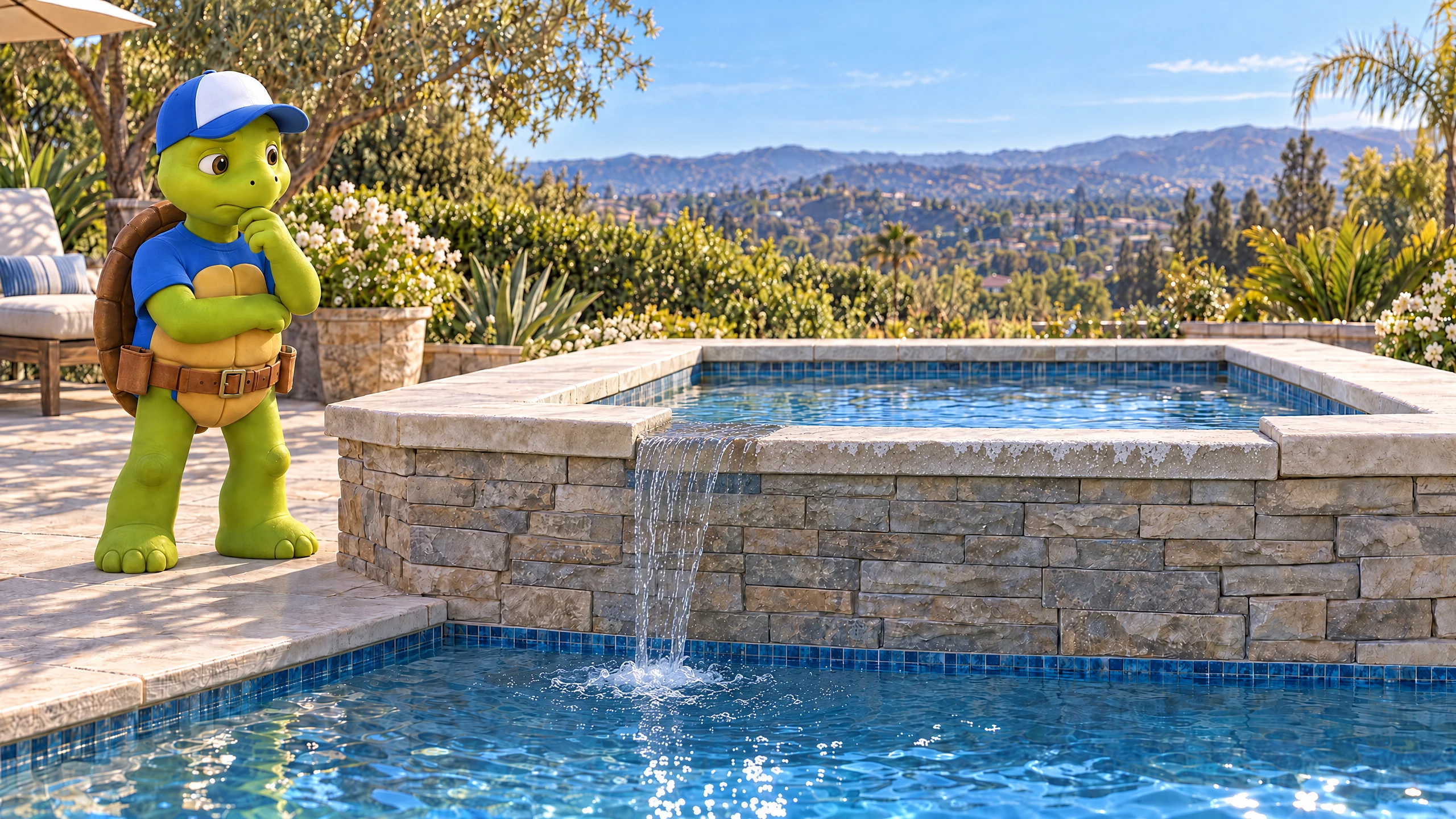
A spillover spa sits higher than the pool. When the spa runs, water is pumped into it and overflows across a lip back into the pool. It only flows when the system is pushing water into the spa.
Waterfalls are different. A sheer descent is a plastic or acrylic fixture that throws a thin sheet off a lip. A rock waterfall is built from boulders or stone with water fed in from the top. Both are usually fed by a return line with its own valve, and some pools give them a separate feature pump.
The diagnosis is different for each, so figure out which one you’re looking at before you start turning valves.
Water only comes off one side
Water takes the lowest point. If the spillover lip or a sheer descent is even slightly out of level, all the flow heads to the low end and the high end goes dry. Hayward’s installation manual for its Sheer waterfall is specific: the lip has to be level and fully supported by mortar when it’s set.
Levels change. Decks settle, coping shifts, and a few years of hard water build calcium on part of the edge. A thin crust on one side is enough to send the water around it.
If the edge is truly out of level, that’s masonry or coping work. If it’s calcium, it’s a cleaning job. Run your finger along the dry part of the lip. Rough and white is calcium. Smooth and dry is level.
Turn the flow down before you judge the level. High flow can hide a low spot by covering the whole edge. At low flow, the water shows you exactly where the low point is.
Calcium on the lip
That white crust on the spillover or the face of a rock waterfall is calcium scale, the same stuff that shows up at the waterline tile. Falling water speeds it up because the water is constantly evaporating off a thin film on the stone.
Light scale comes off with the right cleaning. Thick scale on stone or tile is a bigger job, and our post on removing hard calcium deposits from pool tile walks through what works and what scratches. The same rules apply to a spillover edge.
Weak flow everywhere
If the whole spillover or waterfall is weak, the problem is upstream. Start with the pump. Pentair’s IntelliFloXF manual lists a range of 450 to 3450 RPM and says the higher speeds are for spa jets, water features and priming. A variable speed pump running at its low filtering speed won’t make a waterfall look like much.
Then check the valve that feeds the feature. Someone may have turned it down to quiet the noise or cut splashing during a party and never turned it back. On automated pads, check that the feature or spa mode actually calls for the right valve position and pump speed.
Then the filter. A clogged cartridge cuts flow to everything downstream, including the waterfall. If the filter gauge is higher than usual, our post on the signs your pool filter is going bad is the place to start.
Rough and white is calcium. Smooth and dry is level. A fingertip is the cheapest test on the whole pad.
The spillover runs when it shouldn’t, or won’t when it should
On a combo, the spillover depends on the valves. In spa mode, the return goes to the spa and it overflows. Some pools are set up to keep a little water going to the spa in pool mode too, so the spillover keeps running for looks. That’s a valve setting, not a fixed feature.
If your spillover stopped running in pool mode, a valve actuator may have changed position or lost its setting. If it runs hard in spa mode and the spa won’t heat or the jets are weak, the split is wrong in the other direction. Valve actuators and the gears inside them are covered in our post on what actually breaks on pool equipment.
Sheer descents that sputter or split
Sheer descents have a narrow slot, and anything that gets inside lodges there. A leaf fragment, a bit of pipe glue, a chunk of an old O-ring, and the sheet splits around it. Hayward’s manual for its Sheer waterfall says it requires a cartridge filter plumbed into the supply line, with an optional rock trap for heavy debris.
Flow matters too. Hayward recommends 15 GPM per foot of waterfall width and a mount no more than 3 feet above the water. Too little and the sheet breaks into drips. Too much and it bulges and splashes. Where there are several units, Hayward says to use looped plumbing so the pressure is equal and they all look the same.
So a 4 foot sheer descent wants about 60 GPM on Hayward’s numbers. If it’s sharing a pump with the filter, heater and cleaner, it may not be getting that.
Rock waterfalls and the water level
Rock waterfalls collect leaves in the top pool and in every crack, especially in fall when the oaks and sycamores let go. Leaves block the flow and also feed algae on the shaded parts of the rock. Green or black streaks on a waterfall are an algae problem first, and our post on what real algae removal involves covers it.
Waterfalls also lose water by splash and evaporation. California’s Save Our Water program tells pool owners to shut off waterfalls, fountains and other water features to reduce water loss and evaporation. If the pool level drops faster with the waterfall running, check whether water is splashing over the edge or onto the deck before you assume anything worse.
The same page says a properly maintained cover can cut evaporation by as much as 95 percent. Waterfalls and covers don’t really go together, so the realistic move is running the feature when someone’s there to enjoy it.
Pool waterfall repair or adjustment?
| What you see | Usual cause | Fix type |
|---|---|---|
| Water only off one side | Lip out of level or calcium | Cleaning or masonry |
| White crust on the edge | Calcium scale | Cleaning |
| Weak flow all across | Pump speed, valve, filter | Adjustment |
| Sheet splits or sputters | Debris in the slot or low flow | Clean out, set flow |
| Spillover stopped in pool mode | Valve actuator position | Adjust or repair actuator |
| Several sheers look different | Unequal pressure | Plumbing change |
| Green or black on the rocks | Algae in shaded spots | Brush and treat |
Honestly, most of that list is adjustment and cleaning. The real repairs are an actuator, a feature valve, a cracked fixture, or an edge that needs to be reset.
Asked at the pad, every week
Can I just turn the waterfall up to cover the dry spot? You can, and it might hide it for a while. The low spot is still there, and you’ll be pushing more water, more noise and more splash to cover it.
Should the waterfall run all the time? It doesn’t need to. The water gets filtered either way, and running it adds evaporation and pump time. Most people put it on a schedule or run it when they’re out back.
Why does the spillover make the spa heat slowly? Because every gallon that pours over the edge takes its heat into the pool. A gentle sheet looks just as good and costs less.
Do sheer descents need their own filter? Hayward’s installation manual for its Sheer waterfall says yes, a cartridge filter on the supply line. Older installs sometimes skipped it, and those are the ones that clog.
What to send us
Take a short video of the spillover or waterfall running, plus a photo of the valves on the pad and the filter gauge. Send it through our contact page and we can usually tell if it’s a cleaning, a setting or a part from our pool repair and upgrade service.
We work on Pentair, Jandy, Zodiac, Hayward and Sta-Rite equipment. Or call (805) 586-2055.
Waterfall looking tired?
We’ll check the flow, the valves and the edge and tell you whether it’s a cleaning, a setting or a real repair. Most of the time it’s not the expensive one.
Water takes the low road. Every time.
Primary Pool Services – Ventura County
Thousand Oaks · Westlake Village · Agoura Hills · Camarillo · Newbury Park · Simi Valley · Moorpark · Ventura · Oxnard
Story produced with The Final Code.