Rain, Sprinklers and Pool Pumps: Should Your Equipment Have a Cover?
When a pool pump cover helps, when it cooks the motor, and why the drainage under the pad usually matters more.
Clearance Behind The Motor Fan
Pump Distance From Heater Outlet
Pump Distance From Pool Wall
Grains Of Hardness In Ventura Water
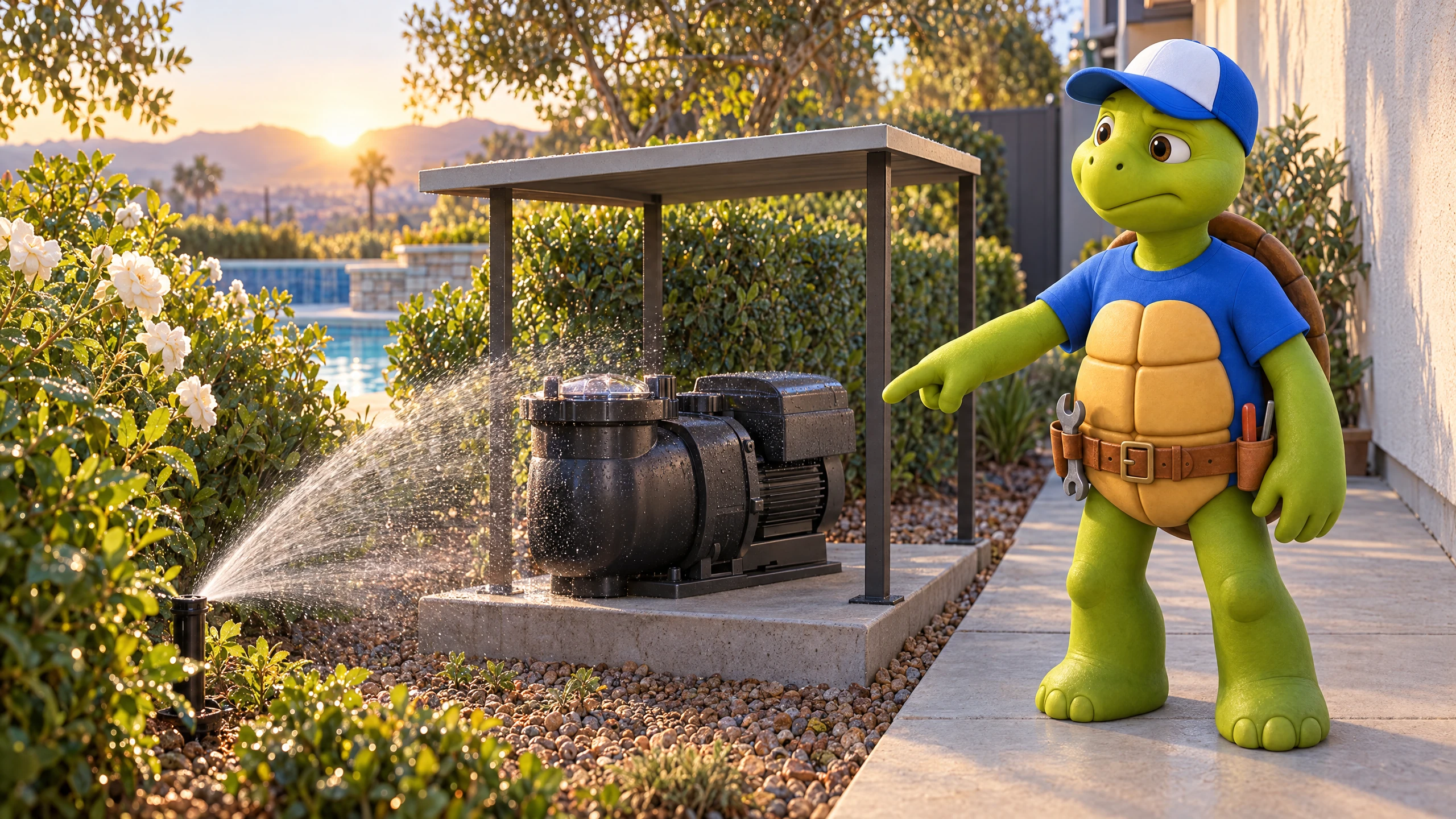
The sprinkler head by the side fence was aimed at the roses once. The roses are gone, the head got kicked a few degrees by somebody’s lawnmower, and now it fires straight into the pump motor at 5 a.m. three days a week. Nobody sees it because nobody is awake. What gets noticed is the rust on the motor, and that’s usually when somebody asks about repairing or upgrading the equipment, or about putting a pool pump cover on it so this stops happening.
Covers can help. They can also cook a motor. The difference is airflow, and both of the big pump makers spell it out in their manuals, which is where most of the rules in this post come from.
A pool pump cover is fine, and sometimes smart, as long as it keeps water off the motor without blocking airflow. Pentair’s IntelliFlo 2 VST guide says any enclosure “must be well ventilated to prevent overheating” and wants at least 3 inches of clearance behind the motor fan. Hayward’s manual says not to wrap a pump in plastic film or bags. A vented hood or a roof over the pad is good; a tarp or a sealed box is not. If the pad floods when it rains, fix the drainage first, because no cover helps a motor sitting in a puddle.
What the manufacturers say about rain and sprinklers
Pentair’s IntelliFlo 2 VST installation guide is unusually specific. It says to install the pump “in a well ventilated location protected from excessive moisture (i.e., rain gutter downspouts, sprinklers, etc.)” and, in the care section, to “protect from continuous splashing or continuous sprayed water.”
Hayward’s owner’s manual for its 1.65 HP variable speed pumps says the pump is designed for outdoor use, then asks you to “select a well-drained area that will not flood when it rains” and says “it is strongly advised to protect the electrical components from the weather.” It also says, in plain words, “Do NOT use water to hose off motor.” Some people do it anyway, every Saturday, with the nozzle on jet.
So the makers agree on two things. Pumps are built to live outside, and they don’t want to be hit by a sprinkler. Those aren’t contradictions. Weather comes and goes. A sprinkler comes back at the same time every morning.
Why a pool pump cover can go wrong
Motors make heat, and they get rid of it by moving air. Hayward’s manual says “pump motors require free circulation of air for cooling.” Pentair’s says to “provide ample cross ventilation.”
A cover that traps that air turns into a small oven. That’s the whole problem with fitted plastic jackets and the throw-a-tarp-on-it approach. Hayward is blunt about it: “To avoid condensation/corrosion problems, do NOT cover or wrap pump with plastic film or bags.” Pentair says to never wrap the motor “with plastic or other air tight materials” during winter storage.
A plastic bag over a pump in a Ventura County fall is a terrarium. The marine layer goes in overnight, the afternoon warms it up, and the moisture you were trying to keep out is now sealed in with the motor.
The rule we go by: if you can’t see daylight through the sides of the cover, the motor can’t breathe through them either.
Covering the motor during a storm
Pentair does allow a temporary cover. Its guide says to “cover the motor to protect it from severe rain, snow and ice,” and that the motor “may be covered during a storm, winter storage, etc., but never when operating or expecting operation.”
That last part matters with a variable speed pump on a schedule. The pump doesn’t know it’s raining. If it’s set to start at 8 a.m. and last night’s storm cover is still on, it runs under the cover. So a storm cover means turning the pump off at the breaker, or pulling the cover before the schedule kicks in. Most people won’t remember.
For most pads around the Conejo Valley, we’d skip the storm cover and deal with the two things that actually do damage: water that sprays and water that pools.
Sprinklers do more damage than rain
Rain here mostly shows up in the winter months and then disappears for a long stretch. Sprinklers run all year, usually before sunrise, and an overspraying head hits the same spot on the motor every single cycle. That’s the “continuous sprayed water” Pentair is warning about.
Hard water makes it worse. Ventura County Public Works puts the City of Ventura’s water at 17 to 53 grains per gallon of hardness and Oxnard’s at an average of 28. Every pass leaves a little mineral behind on the motor housing and the drive, the same white crust that builds up on the tile line at the waterline, only this time on something with electronics in it.
The fix is usually free. Turn the head, cap it, or move that zone to drip. Do that before buying any cover.
Variable speed pumps have more to protect
An old single speed motor was mostly metal and copper. A variable speed pump has a drive, a keypad and circuit boards bolted on top. Pentair’s guide says to put the drive lid back on whenever the pump is left open during service, so “foreign matter (i.e. rainwater, dust, etc.)” doesn’t collect inside the drive, and to “close the keypad cover after every use.” Hayward’s manual says the blank cover on its drive is “important to protect internal electronics.”
California now requires most replacement pumps to be variable speed under the state’s efficiency rule, so more and more pads have one of these drives sitting out in the weather. Check the keypad flap and the drive lid. If either is cracked or missing, replace that before you think about a cover.
Drainage at the pad matters more than any cover
Hayward wants the pump on “a level concrete slab or other rigid base” in a spot that won’t flood. Pentair notes the pump “is not submersible” and says “do not allow the pump to operate if it has been flooded.”
A lot of pads were poured flat and level with the yard. Then the yard grew up around them with mulch, pavers and planter beds, and now the slab is the low spot. In a real storm the water has nowhere to go except around the motor base.
After the next rain, go look. Is water still standing on the slab an hour after it stops? Does a downspout empty toward the equipment? Is there a dirt line on the motor base? A yes to any of those is a drainage job, not a cover job.
No cover fixes a pad that turns into a pond. Water coming up from below doesn’t care what’s on top.
What a good pool pump cover looks like
There are basically five ways people try to protect a pump. Here’s how each one lines up with what the manuals say.
| Option | What it does | Our take |
|---|---|---|
| Fitted plastic or vinyl jacket | Wraps the motor closely | Traps heat and condensation. Both Hayward and Pentair say no airtight wraps. |
| Tarp or trash bag | Whatever was in the garage | Same problem, plus it ends up in the skimmer after the first Santa Ana. |
| Vented hood with open sides | Sheds rain and spray from above | Fine, if the 3 inches behind the fan stay clear and air moves through. |
| Roof or shade over the whole pad | Keeps sun and rain off everything | The best option. Pentair says to shade the motor; Hayward advises shade for pump and filter. |
| Equipment box or enclosure | Hides the pad, cuts some noise | Works only with real cross ventilation. Pentair says any enclosure must be well ventilated. |
Shade is a bonus in the hotter inland valleys like Simi Valley and Moorpark. Hayward’s manual says that although the pump is built for outdoor use, “it is advised to place pump and filter in the shade.”
Don’t box in the heater
If you build a roof or an enclosure over the whole pad, the heater changes the math. Gas heaters vent hot exhaust, and Pentair wants its pump installed at least 3 feet from the heater outlet. Heaters have their own clearance rules for roofs and overhangs, so read the heater’s manual before anyone starts framing.
If the heater is already acting up, that’s a separate repair-or-replace question, and you want it answered before you build a structure around it.
Keep the service side open. Pentair asks for that 3 inches behind the motor so it can be pulled for repair. An enclosure that has to be unscrewed before anyone can reach the pump turns a one-hour job into a longer one.
Asked at the pad, every week
Can a pool pump get rained on? Yes. Hayward says its pumps are designed for outdoor use. The real enemies are standing water, downspouts and sprinkler spray that hits the same spot every day.
Should I cover my pool pump in winter? Not usually here. Pentair allows a temporary cover for storms or winter storage, but never while the pump runs or is scheduled to run, and never an airtight one.
The pad flooded and the pump sat in water. Can I turn it back on? Pentair says not to run a pump that has been flooded. Leave it off at the breaker and have it checked. Water in a motor tends to come back later as bearing noise and other pump repair problems.
Can I hose the dust off the motor? Hayward’s manual says “Do NOT use water to hose off motor.” A dry brush or a rag does the job.
Walk the pad before you buy anything
Next time the sprinklers run, go stand by the equipment and watch. Take a photo of anything that gets wet, the pad after a rain, and the label on the motor. Send those through our contact page and we’ll tell you whether the answer is a cover, a roof, a drainage fix or a sprinkler adjustment.
On weekly maintenance, the tech sends an email report with photos after every visit, so a sprinkler that’s drifted onto the pump shows up early. We work on Pentair, Jandy, Zodiac, Hayward and Sta-Rite equipment, or call (805) 586-2055.
Sprinkler hitting the pump?
We’ll look at the motor, the drive and the drainage under the pad, and tell you what actually needs protecting. Sometimes the whole fix is turning one sprinkler head.
Water the plants. The pump isn’t one.
Primary Pool Services – Ventura County
Thousand Oaks · Westlake Village · Agoura Hills · Camarillo · Newbury Park · Simi Valley · Moorpark · Ventura · Oxnard
Story produced with The Final Code.