Fall Leaves in the Pool: What They Do to Your Water and Your Equipment
Leaves in the pool cost you chlorine, stain the plaster and starve the pump. Here’s what happens, in the order it happens.
Length Of A Sycamore Leaf
Peak Santa Ana Season
Max Wait For A Pump To Prime
CDC Minimum Free Chlorine
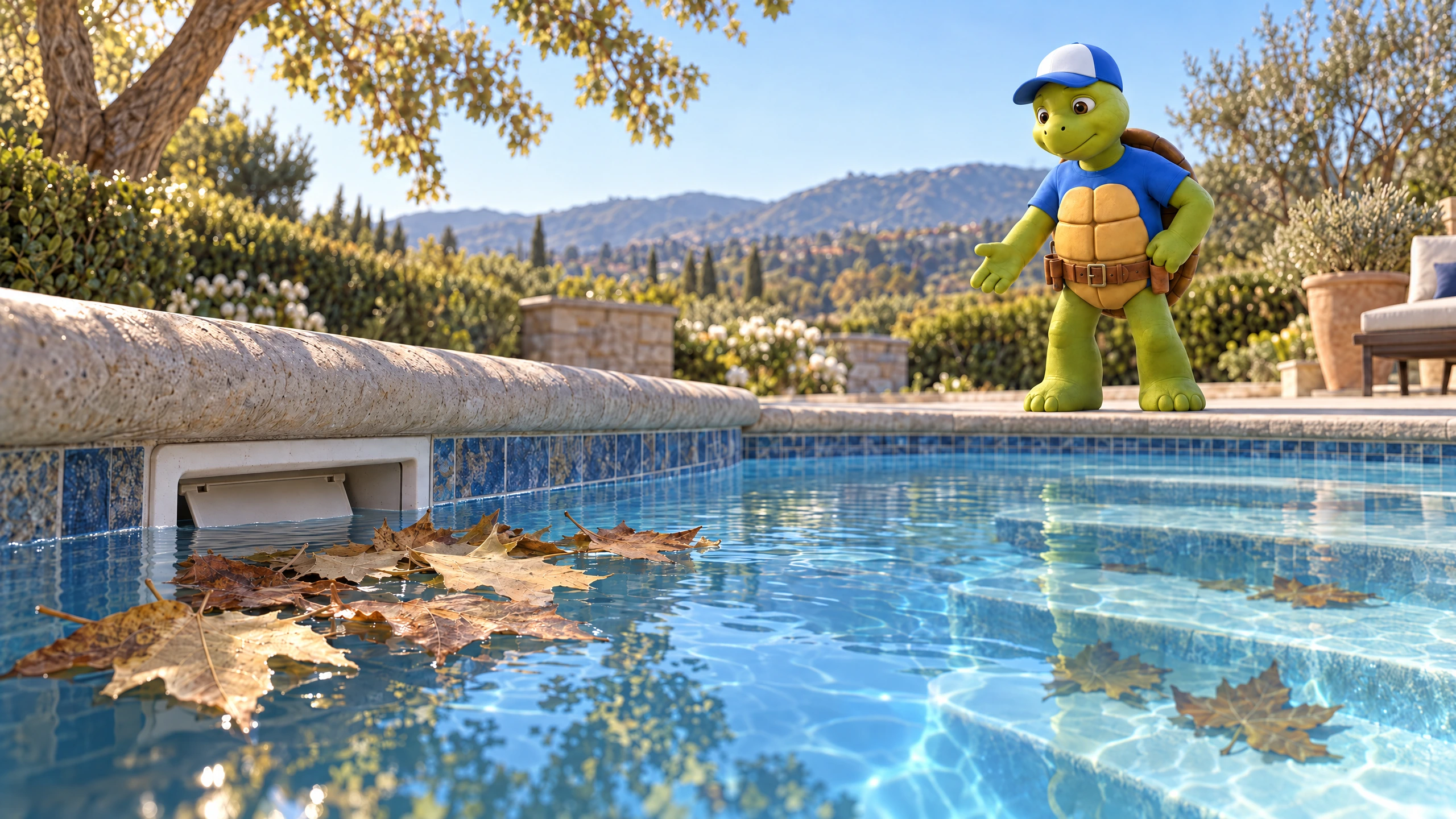
The Santa Anas blow through overnight, and by morning there’s a sycamore leaf bigger than your hand parked on the steps, a dozen more sinking toward the main drain, and a skimmer lid that won’t sit flat because the basket underneath is packed solid. This is a normal fall week for a lot of yards around the lake, and it’s a big part of pool service in Westlake Village once the wind starts.
Leaves in the pool look like a cosmetic problem. They aren’t. They change the water chemistry, they can leave marks on the plaster, and the ones that make it into the plumbing go after the pump. Here’s how each of those happens, and what to do about it.
Leaves in a pool use up chlorine as they break down, release tannins that can stain plaster in the shape of the leaf, and add phosphorus that feeds algae. The bigger risk is mechanical: a skimmer or pump basket packed with leaves starves the pump of water, and Hayward’s manual says running a pump dry can damage the seals. Skim leaves off the surface before they sink, empty both baskets after every windy day, and check chlorine more often until the trees are bare.
Why fall is leaf season here
A UCLA atmospheric sciences page on the Santa Ana winds says they are “most common during the cool season stretching from October through March.” That’s the same stretch when deciduous trees are dropping, so the wind and the leaves show up together.
The worst offender in a lot of Conejo Valley yards is the California sycamore. Oregon State University’s landscape plant database lists its leaves at 15 to 20 cm long, which is roughly 6 to 8 inches. One of those can cover a skimmer opening by itself. Oak leaves are smaller and stiffer, and they like to collect in the corners and on the steps.
What leaves in the pool do to your chlorine
The CDC lists the things that reduce chlorine in a pool, and dirt is on the list along with sunlight. A pile of wet leaves is a lot of dirt. Everything organic that lands in the water gets attacked by the chlorine, and the chlorine that’s busy with leaves isn’t available for anything else.
The CDC recommends at least 1 ppm of free chlorine in pools, or at least 2 ppm if the pool uses cyanuric acid. A pool that held fine all summer can drop under that in a windy week, especially if the leaves sit on the bottom for days.
Get them while they float. A leaf on the surface is a 5 second job with a skimmer net. The same leaf on the bottom three days later is a brush job, a vacuum job and a chlorine problem.
Tannins and the leaf-shaped stain
Leaves carry tannins, the same compounds that make tea brown. Orenda, a pool chemical maker, explains that tannins are released as organic material decays, and that the stains are sometimes “the exact shape of leaves.” Its write-up notes that tannins can also tint the water a brownish-green.
The fix Orenda describes is unglamorous: get the leaves and the basket debris out first, raise the chlorine, and brush the stained areas for about a week. Most organic stains fade that way. A stain that ignores chlorine and brushing may not be organic at all, and that’s when people start asking what an acid wash actually does. Try the boring fix first.
Phosphates: leaves feed algae
South Dakota State University Extension, citing a USGS study, calls fall leaf litter “a primary source of nutrients in stormwater, particularly phosphorus,” and points to how easily leaves leach once they’re wet. A pool full of soaking leaves is the same situation in a smaller bowl.
Phosphorus doesn’t turn a pool green by itself, but it gives algae something to work with when the chlorine dips. That’s the combination fall sets up: more food, less sanitizer. If you’re already past cloudy and into green, that’s a full algae removal job, and leaves are only part of the story.
Leaves don’t turn a pool green on their own. They use up the chlorine and leave phosphorus behind, and algae does the rest.
The skimmer and pump baskets are where it gets expensive
Leaves that float get pulled into the skimmer. The skimmer basket catches the big ones, and anything that slips past ends up in the pump’s strainer basket. When either one packs solid, the pump can’t get water.
Hayward’s manual lists a “strainer basket or skimmer basket loaded with debris” as a cause of trouble, and its fix is to “clean the basket, and refill the strainer housing with water.” It also says to “clean strainer basket regularly. Do NOT strike basket.” Banging a basket on the deck to empty it is how you end up buying a new one.
Why a clogged basket can ruin a pump
Hayward’s manual says to “NEVER OPERATE THE PUMP WITHOUT WATER,” and that “running pump dry may damage seals, causing leakage, flooding, and voids warranty.” A pump pulling against a skimmer full of sycamore leaves is getting close to dry.
You can usually hear it. The pump gets louder and rougher, the strainer lid shows air instead of water, and the returns go weak. A shaft seal that cooked once tends to start dripping later, and a dripping seal eventually becomes a pump repair with bearings in it.
If the pump lost prime, Hayward says priming can take up to 10 minutes, and to stop the motor and find the cause if it doesn’t prime in that time. A clean basket and a full strainer housing fix most of these. If it still won’t catch, Hayward notes that “any self-priming pump will not prime if there are suction air leaks.”
What gets past the baskets
Leaves break into fragments, and the fragments go to the filter. A fall full of leaf grit shows up as rising filter pressure and shorter runs between cleanings. If the pressure climbs back fast right after a cleaning, read up on the signs a pool filter is going bad before blaming the trees for everything.
Pool cleaners have their own limits. A suction cleaner sends what it picks up to the skimmer or the pump basket, so on a heavy leaf day it can clog things faster. Pressure cleaners with their own debris bag need that bag emptied, or they just drive around full.
A week of leaves, problem by problem
| Problem | What you see | What to do |
|---|---|---|
| Floating leaves | Leaves on the surface after wind | Net them the same day, before they sink |
| Sunken leaves | Dark patches on the floor, near the drain | Brush and vacuum; test chlorine afterward |
| Low chlorine | Dull water, test under 1 ppm | Bring free chlorine back up and retest the next day |
| Tannin stains | Brown marks shaped like leaves | Remove debris, raise chlorine, brush for about a week |
| Packed baskets | Weak returns, loud pump, air in the lid | Turn off the pump, empty both baskets, refill the strainer |
| Climbing filter pressure | Gauge higher than after the last cleaning | Clean the filter; check it if pressure returns fast |
Asked at the pad, every week
Is it bad to leave leaves in pool water overnight? One night won’t ruin anything. A week of leaves on the floor will cost you chlorine and possibly a stain. Pull the floaters before bed if you can; they’re the easy ones.
Should I run the pump longer when leaves are falling? Only if the baskets can keep up. A longer run with a packed skimmer is just more time pulling against a clog. Empty first, then decide.
Does a leaf net over the pool help? Yes, if it’s tight enough that leaves don’t pile up in the middle and dump in when you pull it off. Anything that keeps leaves off the water beats chasing them on the floor.
Can I turn the pump off during a Santa Ana to stop the skimmer clogging? You can, but the leaves still land and sink, and the water still loses chlorine. You’re trading a clogged basket for a dirty floor.
Keep the baskets empty until the trees are bare
During leaf season, the job is basically netting, baskets and chlorine, more often than you’d do it in July. If you’d rather not, that’s what weekly pool maintenance covers, and the tech emails a report with photos and water readings after every visit, so you can see the baskets and the chemistry without walking outside in the wind.
If the pump already sounds rough or the floor is stained, send us a note with a photo and we’ll take a look. We service Pentair, Jandy, Zodiac, Hayward and Sta-Rite equipment, or call (805) 586-2055.
Skimmer full again?
Fall leaves are a weekly problem for a few months, and the pump pays for the weeks nobody empties the baskets. We’ll keep up with the netting, the baskets and the chlorine until the trees are done.
The sycamore isn’t going anywhere. The leaves can.
Primary Pool Services – Ventura County
Thousand Oaks · Westlake Village · Agoura Hills · Camarillo · Newbury Park · Simi Valley · Moorpark · Ventura · Oxnard
Story produced with The Final Code.