Is a Saltwater Pool Really Less Maintenance? An Honest Answer
It’s a chlorine pool that makes its own chlorine. The rest of the list stays.
Replacement Hayward Cell
Pentair Cell Design Life
Hayward’s Ideal Salt Level
Thousand Oaks Water Hardness
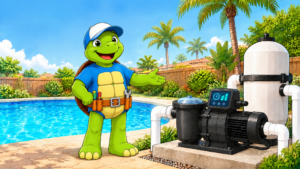
The listing said “saltwater pool” like it was a feature on par with a three-car garage. Six months later you are standing at the equipment pad looking at a gray plastic tube with white crust packed between its plates, a salt light blinking on the power center, and a jug of muriatic acid you did not expect to own. That is honest saltwater pool maintenance in one picture, and it’s the part of weekly pool maintenance the sales pitch left out.
A saltwater pool is a chlorine pool. The difference is where the chlorine comes from. Instead of you buying it and pouring it in, a salt cell on the plumbing runs electricity through lightly salted water and makes chlorine on site. That removes one chore completely. It doesn’t remove the others, and it adds a few new ones.
Somewhat less work, not no work. Saltwater pool maintenance removes buying, hauling and adding chlorine. You still test the water, brush, clean the filter and add acid, usually more acid than before, because salt cells push pH up. You also inspect and descale the cell every two to three months and replace it every several years at around $700 to $1,100.
What a salt system actually does
Orenda, the pool chemistry company, puts it plainly: salt systems “create chlorine by running electricity through salt water.” Hayward’s Aqua Rite manual says the salt in the pool “is constantly recycled,” so the cell keeps reusing the same salt.
What you lose, per that manual, goes out with water. Salt is lost to splash-out, backwashing and draining after rain. “Salt is not lost due to evaporation.” You top it up a few times a year, not every week.
How salty is salty? Not very. Hayward’s Aqua Rite Pro manual lists an ideal range of 2,700 to 3,400 ppm, with 3,200 ppm as optimal. Pentair’s IntelliChlor installation and user’s guide recommends 3,600 ppm, lists an operating range of 3,600 to 4,500 ppm, and warns the unit shuts off below 2,600. You can taste it if you try. Most people don’t try.
What really goes away with saltwater pool maintenance
The chlorine runs. No more bucket of tablets in the garage, and no jugs of liquid chlorine sloshing around the trunk. The cell doses a little chlorine every hour the pump runs, which gives steadier levels than a big weekly dump that peaks on Monday and fades by Friday.
That’s a real improvement, and on cost it’s real too. HomeGuide’s 2026 comparison puts chlorine tablets and other chemicals at $175 to $750 a year for a traditional pool, against $90 to $180 a year in salt for an average 18,000 gallon pool, at $10 to $20 per 40-pound bag.
That’s the list. It’s one item long.
What doesn’t go away
Everything that isn’t sanitizer. Leaves still sink and walls still need brushing. The filter still loads up, and a clogged filter means low flow, which means the cell stops making chlorine. A salt cell only makes chlorine while water moves through it, so it’s exactly as good as your pump schedule and your filter.
Testing doesn’t go away either. Hayward’s Aqua Rite Pro manual gives a full chemistry table for its own salt system: free chlorine 1.0 to 3.0 ppm, pH 7.2 to 7.8, stabilizer 60 to 80 ppm, alkalinity 80 to 120 ppm, calcium hardness 200 to 400 ppm. A salt system doesn’t read any of those for you. It makes chlorine at whatever percentage you set, and if you guessed wrong it keeps making the wrong amount with total confidence.
When a cell quits, chlorine goes to zero. Salt pools go green from a dead or scaled cell as fast as tablet pools go green from an empty floater. The green water doesn’t care which one it was.
The pH creep nobody mentions at the sales counter
Salt pools drift up in pH. Orenda explains why: the cell releases hydrogen gas, the bubbles stir the water, and that turbulence drives carbon dioxide out. Losing dissolved CO2 raises pH. Their line: “It’s the loss of CO2 in the salt cell (caused by Hydrogen gas bubbling off) that causes the pH to rise in saltwater pools.”
What that means at the pad is acid, regularly. On a salt pool muriatic acid stops being an occasional correction and becomes a weekly line item. High pH makes chlorine sluggish, and with our fill water it also sets up scale and cloudy water.
Use liquid muriatic acid, not dry acid. Hayward’s manual says sodium bisulfate is “discouraged especially in arid regions where pool water is subject to excessive evaporation,” because the by-product builds up and can damage the cell. If your pool drinks a lot of water in August, that sentence was written about you.
You traded buying chlorine for buying acid. The acid jug is smaller, which counts for something.
Hard water and saltwater pool maintenance in Ventura County
This is where our area gets specific. California American Water’s 2025 report for the Thousand Oaks system puts total hardness at about 140 mg/L, or 8.2 grains per gallon. That’s before evaporation, which takes water and leaves the calcium behind, so the pool gets harder every time you top it off.
A salt cell is a scale magnet. Orenda notes the cathode side of the cell produces sodium hydroxide, and its high pH is what drops calcium out as scale on the plates. Scaled plates make less chlorine. A heavily scaled cell makes very little, and the display won’t always tell you why.
So you inspect it. Pentair says to pull the IntelliChlor cell and check for scale “every two (2) months.” Hayward says to look inside every 3 months or 500 operating hours. Rinse first. If it needs acid, Hayward’s manual gives a 4 to 1 water to acid mix, and Pentair warns not to leave acid in the cell more than 30 minutes. (Both brands are specific about the mix and the time limit for a reason. A cell costs more than the acid.)
Self-cleaning helps, but not enough to skip the check. Pentair’s FAQ says its cells reverse polarity every three hours to minimize scale. Minimize is the honest word. If you already fight calcium scale on the waterline tile, you’ll fight it on the cell too.
Stabilizer: the two big brands disagree
Outdoor chlorine needs cyanuric acid (stabilizer, CYA) to survive the sun, and a salt cell doesn’t add any. You add it, you test it, and you keep it in range.
Which range depends on the manual. Hayward’s Aqua Rite Pro manual calls for 60 to 80 ppm. Pentair’s IntelliChlor guide says 30 to 50 ppm for outdoor pools, and the newer IntelliChlor Plus manual lists 0 to 50. Pentair’s FAQ lists low or high stabilizer as a cause of low chlorine production. Follow the manual for the cell on your pad, not a forum post and not the other brand.
The cell is a consumable, and it isn’t cheap
The same Pentair guide says the cell is designed for about 10,000 hours, “roughly five (5) years of average use.” Angi’s 2026 conversion data says about five years and $700 to $1,100 to replace. HomeGuide says $600 to $1,000 every 3 to 6 years.
Real 2026 listings land at the top of those ranges. Doheny’s lists the Hayward T-Cell-15 replacement cell (rated for 40,000 gallons) at $1,099 and a Pentair IntelliChlor IC40 replacement cell at $1,149.
| Item | 2026 price | Source |
|---|---|---|
| Conversion, installed | $500 to $2,500, average $1,000 | Angi |
| Hayward W3AQR15 complete system | $2,199 | Leslie’s listing |
| Hayward T-Cell-15 replacement cell | $1,099 | Doheny’s listing |
| Pentair IC40 replacement cell | $1,149 | Doheny’s listing |
| Salt, per 40-pound bag | $10 to $20 | HomeGuide |
Notice the complete Hayward system is $2,199 at retail before anyone touches a wrench, near the top of Angi’s installed range. Budget from the equipment on your pad, not the headline average.
Now the math people skip. Spread a $1,100 cell over five years and it’s $220 a year, before salt. Add $90 to $180 in salt and you’re at $310 to $400 a year. HomeGuide puts tablets and chemicals at $175 to $750, so salt beats the expensive end of that range and loses to the cheap end. Salt can save money. It usually saves less than the brochure implied, and a cell that scales up and dies early in hard water erases the savings. When it does fail, that’s a pool equipment repair call, and it’s worth confirming the cell is actually spent before paying for a new one.
Salt is corrosive. Your stone, metal and heater know it
Pentair’s guide doesn’t soften it: “Salt is an inherently corrosive material,” and metal parts and certain natural and man-made surfaces are “particularly susceptible.” Hayward’s manual says to consult a stone specialist before installing a salt system in a pool with natural stone coping or adjacent stone decking.
Metal is next: rails, ladders, light rings and the heater. Raypak’s RP2100 manual caps salt at 4,500 ppm and says chlorinators “must feed downstream of the heater,” with a check valve between the heater outlet and the chlorinator. It also warns that salt chlorinators run more efficiently in heated water and, unchecked, can produce enough chlorine to damage the heater, “which is not covered under warranty.” Raypak’s current warranty excludes damage from “electrolysis due to an improperly installed salt chlorine generator.”
That’s the copper heat exchanger, which is the part that ends heaters. We went through what that failure costs in whether to repair or replace a pool heater. The short version: get the plumbing order right before you add salt.
New plaster? Wait. Pentair says to wait at least one month after construction before adding salt. If you’re resurfacing the pool and converting at the same time, schedule the salt for later.
A week of chores, salt vs traditional chlorine
A normal week on a residential pool, side by side. Intervals for cell inspection come from the Hayward and Pentair manuals cited above.
| Chore | Traditional chlorine | Saltwater |
|---|---|---|
| Buy and haul chlorine | Weekly or every other week | Gone |
| Add sanitizer | Weekly, tabs or liquid | Automatic while the pump runs |
| Test chlorine and pH | Weekly | Weekly |
| Add acid | As needed | Usually weekly, often more of it |
| Skim, brush, vacuum, empty baskets | Weekly | Weekly |
| Check filter pressure | Weekly | Weekly, since low flow stops the cell |
| Check salt level | No | Monthly, and after rain or backwash |
| Inspect cell for scale | No | Every 2 to 3 months |
| Stabilizer and calcium | Monthly test | Monthly test |
Count the rows. Salt removes one chore and automates another. It adds two.
A salt system is a better chlorinator, not a pool that takes care of itself.
Asked at the pad, every week
Is salt water easier on skin? Some owners say it feels softer. It’s still a chlorinated pool, just dosed more evenly.
Can I use any salt? Hayward says sodium chloride over 99% pure, the kind sold as coarse solar or water softener salt.
Why does my salt reading drop when the pool is full? A scaled cell or a dirty sensor can read low. Check the cell before you add bags, because the only way to lower salt, per Hayward, is to drain some water and refill.
Does the cell work in winter? Hayward’s Aqua Rite stops generating below 50°F water temperature. On a cold week you may need to add chlorine by hand.
Before you convert, or before you blame the cell
Do one thing this week: pull the cell and look inside it. With the pump off and the power center off, unscrew the unions, and hold it up to the light. Clean plates mean your problem is somewhere else. White crust bridging the plates means you found your low chlorine.
If you’re weighing saltwater pool maintenance against what you do now, write down your pool’s gallons, your heater’s make and model, and whether your coping is natural stone. Then send us those details and we’ll talk through whether salt makes sense on your pad.
We service Pentair, Jandy, Zodiac, Hayward and Sta-Rite equipment. Call (805) 586-2055 and we’ll get a tech out to the pad.
Salt light blinking again?
A scaled cell, a bad flow reading and low salt all look the same on the display. A tech can tell them apart in a few minutes. Have your cell model and pool size ready when you call.
We look at the cell before we quote it.
Primary Pool Services – Ventura County
Thousand Oaks · Westlake Village · Agoura Hills · Camarillo · Newbury Park · Simi Valley · Moorpark · Ventura · Oxnard
Story produced with The Final Code.