Tile, Plaster, Pebble or Coping: What to Replace First in a Pool Remodel
Coping and tile go in before the finish. The pool gets drained once.
Waterline Tile
New Coping
Pebble Finish Life
New Plaster Start-Up
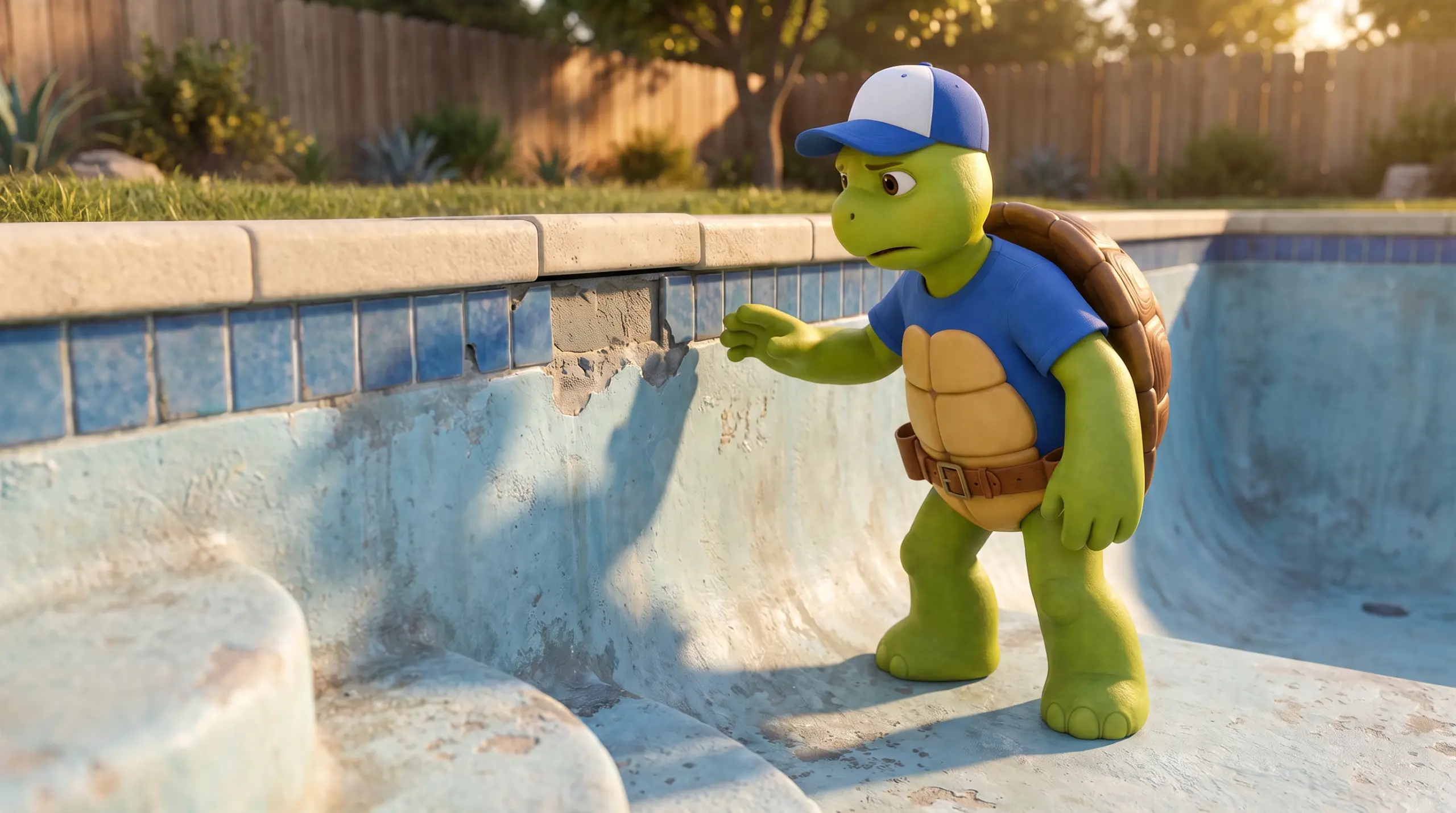
Stand at the equipment pad with the pump off and look back at the pool. Three waterline tiles are missing in the deep end, one coping stone rocks when you step on it, and the plaster feels like a nail file on the steps. Two remodel bids sit on the patio table. Everybody asks about pool tile replacement cost first, but the order of the work saves more money than any line on either bid, and a drained pool is also the cheapest moment you will ever get for the pool repairs and upgrades that are hard to reach with water in it.
The order is simple. Coping and waterline tile go first, because the finish has to meet them. Plaster or pebble goes last. And the whole job happens inside one drain, because every extra drain costs money, water and a restart of the new finish’s chemistry.
Fix or replace the coping and the waterline tile first, then resurface with plaster or pebble last, all while the pool is drained once. The finish crew works up to the tile line, so tile done after new plaster means cutting into a surface you just paid for. Pool tile replacement cost for a waterline band runs about $25 a linear foot per Angi, or $1,900 to $4,800 for a 16 by 32 foot pool per HomeGuide.
Why plaster goes last: the finish crew works to the tile line
Picture the top of your pool wall in cross section. Coping sits on the bond beam, the thick concrete ring at the top of the shell. Waterline tile sits just below the coping. Plaster or pebble covers everything below the tile.
So the plaster crew’s edge is your tile line. One Houston plastering contractor, Express Pool Plastering, spells out its process in writing: any tile work on the contract is done before the pool is plastered, and the crew saw cuts with a diamond masonry blade to undercut the tile line. That undercut is where the new finish tucks in.
Reverse the order and a crew is chiseling old tile and mortar off a few inches above a finish that is weeks old, then patching plaster to meet the new tile. You paid for that edge once. Now you pay again, and the patch won’t match.
Nobody in the trade argues about whether plaster goes last. They argue about everything else.
Coping or tile first?
Depends on the crew. Some set tile first because it establishes the level line and the coping follows it. Others set coping and push the tile up under it. Both work, as long as both are done before the finish crew shows up.
The practical point comes from Ask the Pool Guy, a Michigan renovation outfit: if you’re redoing the coping, do it at the same time as the tile, because pulling the coping stones can knock the tile off. Plan to replace one and keep the other, and a coping repair can turn into a tile job by lunch.
Drain the pool once
Draining isn’t free, and refilling can be worse. HomeGuide’s resurfacing guide puts draining and cleaning at $600 to $650, a garden hose refill at $40 to $400, and a water delivery truck at $400 to $2,000. Where your fill lands in that range depends on your water district’s tiers, and a pool refill pushes a household deep into the expensive ones.
Then the new finish needs its start-up. The Pool and Hot Tub Alliance’s fresh fill start-up for plastered pools calls for continuous filtration for seven days, brushing at least twice a day, no chlorine for 48 hours, and frequent brushing, testing and adjustment for the first 28 days. Drain the pool again six months later for tile and you are back to fill day, with a six month old finish sitting empty in the sun.
And Ventura County fill water is hard. Every refill brings in a fresh load of calcium, which is why the tile line scales up the way it does (more on that below). Fewer refills, less calcium.
Pool tile replacement cost in 2026
Angi’s pool tile guide, updated May 2026, prices waterline tile at about $25 a linear foot and a standard tile job at about $25 a square foot. Labor alone runs $30 to $120 an hour, or $4 to $32 a square foot. Partial repairs land at $2,000 to $5,000, and re-adhering a few loose tiles is about $250.
HomeGuide’s January 2026 numbers run $20 to $50 a square foot installed, and it prices waterline tile by pool size:
| Pool size | Waterline tile, installed | Full tile interior, installed |
|---|---|---|
| 10 x 20 ft | $1,200 to $3,000 | $6,500 to $16,400 |
| 16 x 32 ft | $1,900 to $4,800 | $10,700 to $26,800 |
| 20 x 40 ft | $2,400 to $6,000 | $13,600 to $34,000 |
Those two sources agree better than they look. A 16 by 32 pool has 96 feet of perimeter, so Angi’s $25 a foot comes to $2,400, inside HomeGuide’s range.
The spread inside those ranges is mostly the tile you pick. Per square foot, for the tile alone:
- Porcelain: $2 to $25 per HomeGuide, $2 to $56 per Angi. The workhorse on most waterlines, and the cheap end of that range is fine.
- Ceramic: $2 to $20 per HomeGuide, $1 to $35 per Angi. Fine at the waterline if it’s rated for pools.
- Glass: $8 to $50 per HomeGuide, $7 to $50 per Angi. Looks great, shows every water spot, and costs more to set because it’s usually small mosaic sheets.
- Stone: travertine $7 to $30 and marble $5 to $40 per HomeGuide. Angi has granite at $5 to $15 and limestone at $2 to $11. Stone looks the most expensive and, at the high end, is.
These are national numbers. Read every one of them as a floor for a Ventura County backyard.
Angi says pool tile lasts five to 10 years, depending on how well it’s maintained. The tile itself usually outlives that. What fails is the bond behind it and the grout between it. Tap the tile line with a screwdriver handle: a hollow sound means the tile has let go, even if it hasn’t fallen off yet.
Coping: materials, costs and when it has to go
HomeGuide’s January 2026 coping guide puts installed coping at $40 to $80 a linear foot on average, and says replacing existing coping costs more than installing new. By material:
- Concrete: $40 to $55 a foot
- Brick: $45 to $65
- Composite: $45 to $70
- Pavers: $50 to $70
- Sandstone: $55 to $75
- Travertine: $55 to $80
- Natural stone: $60 to $80
Angi’s figure is lower, $30 to $50 a linear foot installed. On that same 96 foot perimeter, HomeGuide’s range comes to about $3,840 to $7,680 before anyone pulls a single old stone.
HomeGuide says quality coping lasts 10 to 30 years, with concrete around 15 to 25 and natural stone past 30 with care. It rarely dies of old age. It dies of water. A loose stone or a cracked joint lets water down into the bond beam, and HomeGuide prices bond beam repair at $70 to $80 a linear foot, a figure that typically includes new tile and coping anyway. A loose coping stone is a cheap fix this year and a structural one later.
Rocking coping is the one item on the remodel list that gets more expensive every month you look at it.
Plaster or pebble: how long each finish lasts
The last layer costs the most, so we’ll keep it short. The full numbers live in our post on when a pool needs resurfacing.
HomeGuide’s resurfacing guide gives white plaster 7 to 12 years at $6 to $8 a square foot, quartz 10 to 15 years at $7 to $10, and pebble 15 to 20 plus years at $7 to $15. Pebble Technology, the company behind PebbleTec, says on its guide to how long a pebble finish lasts that pebble lasts over 20 years with proper maintenance and chemistry, while plaster needs resurfacing every 5 to 10 years. (A pebble company thinks pebble lasts longer than plaster. Shocking, but the independent ranges point the same way.)
Pebble is rougher underfoot, costs more up front, and in our renovation post we said it has no payback in the investment sense. What it does buy is fewer drains over the life of the pool, and on hard water that’s worth something.
The whole remodel on one table
Lifespans and costs from the sources above. National numbers, so expect the Ventura County version to run higher.
| Component | Typical life | 2026 cost | Replace when |
|---|---|---|---|
| Waterline tile | 5 to 10 yrs (Angi) | About $25 per linear ft (Angi); $1,900 to $4,800 on a 16 x 32 pool (HomeGuide) | Tiles sound hollow, crack, fall off, or carry scale that won’t come off |
| Coping | 10 to 30 yrs (HomeGuide) | $40 to $80 per linear ft (HomeGuide); $30 to $50 (Angi) | Stones rock, joints open, cracks let water behind the tile |
| White plaster | 7 to 12 yrs (HomeGuide) | $6 to $8 per sq ft (HomeGuide) | Rough to the touch, delaminating, stains that survive an acid wash |
| Pebble | 15 to 20+ yrs (HomeGuide); 20+ (Pebble Technology) | $7 to $15 per sq ft (HomeGuide) | Pebbles popping loose, bare spots, hollow sections |
The lifespans don’t line up, which is the whole case for bundling. The expensive mistake is plaster at year eight, tile that seems fine, and a remodel that replaces only the plaster. Two years later the tile goes, and the new plaster is in the way.
Is it tile that needs replacing, or calcium?
A lot of tile that looks finished is just scaled with calcium, which builds fast on Ventura County water. As our calcium post explains, carbonate scale comes off with acid or a pumice stone and silicate scale needs mechanical removal like bead blasting. Either way the tile underneath is often fine, and cleaning it costs a fraction of the pool tile replacement cost. Our post on removing calcium from pool tile walks through the drop test.
Same logic for stained plaster that’s still smooth. Read what an acid wash actually does before anyone quotes a resurface. If the pool is getting drained anyway, draining and acid washing is the cheap end of the same visit.
Replacing scaled tile to get rid of scale is like buying a new car because the windshield is dirty. Clean it first. Replace what’s hollow, cracked or missing.
What a permit adds to the list
A like-for-like job (same tile line, same coping, new finish) often doesn’t need a permit. New plumbing, wiring or bond beam repair usually does. If yours needs one, California’s Swimming Pool Safety Act comes along. Health and Safety Code Section 115922 says that when a permit is issued to remodel an existing pool at a single-family home, the pool has to have at least two of seven drowning prevention features, and the building official inspects them before final approval. Section 115928.5 says a remodel permit also requires the suction outlets to be upgraded to antientrapment grates meeting ANSI/APSP-16.
Know both before the pool is empty. Drain covers are easier to deal with when you can walk to them. Our post on California pool fence law lists all seven features. The bigger picture on scope, from a cosmetic refresh to a full remodel, is in our guide to when a pool actually needs renovating.
Questions we get at the tile line
Can I replace waterline tile without replastering? Yes. The water gets lowered below the tile, not the whole pool drained, and the crew works above the finish. It only makes sense when the plaster still has years in it.
Can I keep my tile and just replaster? Also yes. That’s what the undercut at the tile line is for. Make sure the tile is actually sound first: tap it. Hollow tile under a new finish is a problem you just scheduled for later.
What does the pool need after the new finish goes in? Four weeks of brushing and tight chemistry on the PHTA start-up schedule. That is the stretch where weekly pool maintenance earns its keep, because a new finish that starts with bad water never gets its full life.
Walk the perimeter before you sign anything
Before either bid gets a signature, walk the edge with a screwdriver. Tap the tile every few feet and note where it sounds hollow. Step on each coping stone and note which ones move. Feel the plaster on the steps. Photograph all of it.
That list tells you whether this is one job or three in one drain, and it keeps a bid honest. Send us the photos through the site along with the pool’s size and roughly how old the finish is.
We service Pentair, Jandy, Zodiac, Hayward and Sta-Rite equipment, and a drained pool is a good day to look at the pad too. Call (805) 586-2055 and we’ll get a tech out to look at the pool before anyone starts chiseling.
Tile first, finish last, one drain
Hollow tile, rocking coping and rough plaster don’t always fail in the same year. Walk the perimeter, take photos, and call before the pool gets drained so the work happens in the right order.
We look at the pool before we quote it.
Primary Pool Services – Ventura County
Thousand Oaks · Westlake Village · Agoura Hills · Camarillo · Newbury Park · Simi Valley · Moorpark · Ventura · Oxnard
Story produced with The Final Code.