What Does a Full Pool Replaster Cost, and What Are You Actually Paying For?
The plaster is one line. The invoice has about ten.
White Plaster Per Sq Ft
LA Area Average Resurface
Top Tier Water Per 100 Gal
Plaster Startup Window
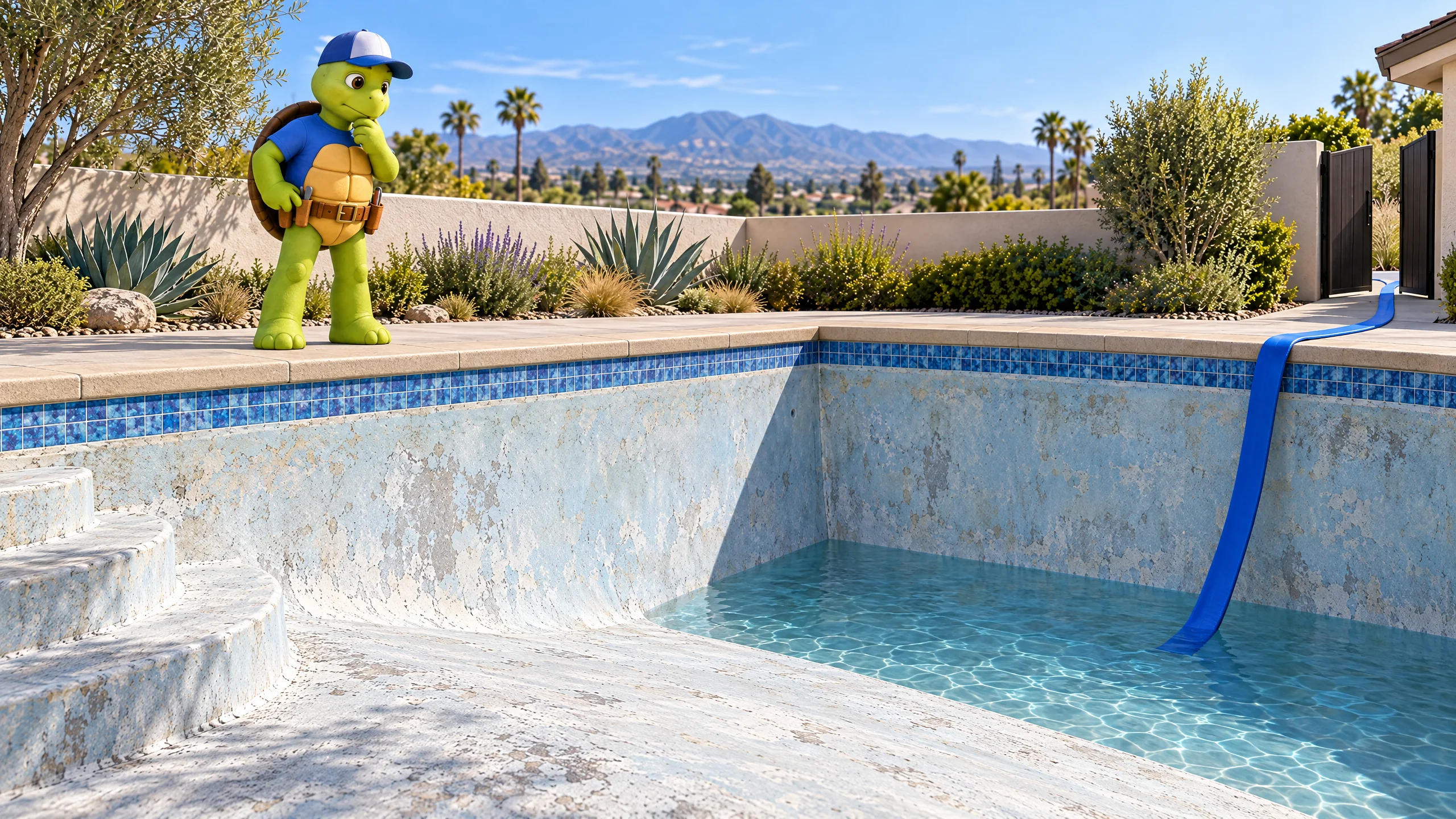
The pump breaker is off, the heater’s gas valve is closed, and a submersible pump in the deep end is pushing water down a blue hose toward the sewer cleanout by the side gate. That is day one of a replaster. The quote that started it probably fits on one page and says something like “replaster, white, $8,500.” Do a pool replaster cost breakdown and that price turns out to be about ten separate jobs stacked into one number, and sorting out which ones are in it is a big part of any pool repair and upgrade conversation.
A one-line quote isn’t dishonest. It just can’t be compared. So here is a typical 16 by 32 foot pool priced line by line with 2026 figures, plus the Ventura County parts: refill water at your meter, where the old water may go, and what our fill water does to new plaster. If you’re still deciding whether the surface is done, start with how to tell when a pool needs resurfacing. This one assumes you’ve decided.
HomeGuide puts white plaster at $6 to $8 a square foot installed, so about $6,000 to $8,000 for a 16 by 32 pool with roughly 1,000 square feet of surface. With draining, refill water and, on some jobs, a bond coat, the pool replaster cost lands around $6,800 to $9,800. Add new waterline tile and it’s about $8,700 to $14,600. Quartz and pebble cost more per foot.
First, measure the pool
Plasterers price by surface area, not gallons. Floor plus walls. For a 16 by 32 foot rectangle that runs 3.5 feet deep at one end and 6 at the other, the average depth is 4.75 feet.
The floor is 16 × 32 = 512 square feet. The walls are the perimeter times the average depth: 96 feet × 4.75 = 456 square feet. Together that’s 968 square feet, close to the 1,000 square foot pool HomeGuide and Angi use as their example. A real deep end slopes, so the true number runs a bit higher. (Kidney shapes get measured the same way, with more muttering.)
Gallons come from the same numbers: 512 × 4.75 = 2,432 cubic feet, and at 7.48 gallons per cubic foot that’s about 18,200 gallons. You pay for it twice: to drain and to fill.
The pool replaster cost, line by line
The whole invoice for that pool. These are published 2026 market numbers and utility tariffs, not our prices.
| Line item | What it covers | 2026 figure | Source |
|---|---|---|---|
| Drain and clean | Pump down, clear debris, wash the shell | $600 to $650 | HomeGuide |
| Surface prep | Remove hollow plaster, sandblast, patch | Usually in the per foot price; full chip-out quoted per job | Homewyse scope |
| Bond coat | Cement coat that grips the old surface | 4 to 5 bags at $180, so $720 to $900 in material | SGM, Pools & Surfaces |
| White plaster, installed | Material and crew | $6 to $8 per sq ft, $6,000 to $8,000 | HomeGuide |
| Quartz, installed | Material and crew | $7 to $10 per sq ft, $7,000 to $10,000 | HomeGuide |
| Pebble, installed | Material and crew | $7 to $15 per sq ft, $7,000 to $15,000 | HomeGuide |
| Waterline tile | Optional, 96 feet of perimeter | $1,900 to $4,800 | HomeGuide |
| Drain covers | Replacement suction covers | $18.99 for a Hayward 8 inch cover | Home Depot listing |
| Pool light | Only if it’s being replaced | $500 to $900 | Angi |
| Fill water | About 18,200 gallons | About $210 to $240 | California American Water tariff |
| Startup | 28 day brushing and chemistry | Ask whether it’s included | National Plasterers Council |
| Permit | Only if your city requires one | Set by the city | Your city |
Low end: $600 drain, $6,000 plaster, $212 water, no bond coat, which is $6,812. High end: $650, $8,000, a $900 bond coat and $237 of water, which is $9,787. Put $1,900 to $4,800 of tile on top and you get $8,712 to $14,587. Angi’s April 2026 Los Angeles page puts the average resurfacing job at $12,496, range $6,816 to $17,040.
Draining: cheap line, local fine print
HomeGuide puts draining and cleaning at $600 to $650. Angi’s Los Angeles numbers split it: $200 to $255 to drain, $285 to clean.
Where the water goes depends on your city. Thousand Oaks allows a sewer cleanout on your property with a call to Public Works first, or the storm drain once chlorine is down to 0.1 ppm. More on those rules in what a pool acid wash actually does. The City of Ventura closes the sewer option. Its pool and spa draining page prohibits pool water in the sewer through cleanouts and allows the street only after chlorine is below 0.1 mg/L. It suggests letting the pool sit five days without chlorine, or using sodium thiosulfate.
Same county, different answers. Whoever handles your pool draining should know which one applies before the pump goes in.
Salt pools cost more to drain. Thousand Oaks says saltwater pools must be hauled by truck to a facility that discharges to the ocean. Ventura bans saltwater from both the street and the sewer. Ask for the hauling line in writing.
Chip-out or bond coat: the line that splits the quotes
This is usually where two honest quotes end up thousands apart. A chip-out removes the old plaster, all of it or the bad sections, back to a surface that will hold. Homewyse’s basic replaster scope, which prices at $6.63 to $7.90 a square foot as of May 2026, covers “sandblast existing surface and patch minor cracks.”
A bond coat is the middle road. SGM’s One Step Bond Kote is a cement coating made to bond new plaster over an existing finish, and SGM says it eliminates sandblasting and chip-outs. A 65 pound bag covers 200 to 250 square feet, and Pools & Surfaces lists it at $180. On our 1,000 square foot pool that’s 1,000 ÷ 250 = 4 bags up to 1,000 ÷ 200 = 5 bags, or $720 to $900 before anyone picks up a trowel.
The catch is in SGM’s own instructions: check completely for hollow areas and remove all loose plaster first.
A bond coat over sound plaster is a good product. A bond coat over hollow plaster is new plaster glued to the old problem.
The finish: material and the crew
Angi’s materials table lists plaster at about $4 a square foot. Read that as the material and set it against HomeGuide’s $6 to $8 installed, and the crew is roughly a third to half of the number. Angi puts labor at $45 to $65 an hour; HomeGuide says the job takes 5 to 7 days.
Going from white plaster to quartz on 1,000 square feet adds $1,000 to $2,000 on HomeGuide’s numbers. Pebble’s $7 to $15 range tells you almost nothing until someone names a product.
Tile, drain covers and the light
Waterline tile. HomeGuide’s January 2026 tile guide puts waterline tile on a 16 by 32 pool at $1,900 to $4,800. Angi says waterline tile runs about $25 a linear foot, and 96 feet × $25 = $2,400, right in that range. If the tile is sound and only scaled, clean it instead: calcium scale on pool tile usually comes off without a grinder.
Drain covers. The cheapest line on the invoice, with the most safety riding on it. The federal Pool Safely FAQ says compliant covers are marked with a service life, “Life: X Years.” Wisconsin’s consumer protection agency says most covers last 5 to 20 years because chlorine and UV break them down. A Hayward 8 inch VGB cover is $18.99 at Home Depot. If yours is past its date, an empty pool is the easiest time you’ll ever have to swap it.
The light. The fixture gets pulled from its niche so the crew can plaster around it. If it’s an old incandescent, Angi puts a replacement at $500 to $900, and our post on replacing a pool light covers what to choose.
Fill water, priced at your meter
HomeGuide says a hose fill runs $40 to $400 and a delivery truck $400 to $2,000. The local tariff is more precise.
California American Water serves parts of Thousand Oaks, Newbury Park and an area next to Camarillo. Its residential rates, effective January 1, 2026, are billed per 100 gallons: $0.8069 for the first 85 units in a month, $0.9413 for the next 50, $1.0578 for the next 163, and $1.1932 above that. On top of those sit a purchased water surcharge of $0.1014, a purchased power surcharge of $0.0024 and a CEBA surcharge of $0.0034, which add up to $0.1072 per unit.
Our 18,200 gallons is 182 units, and on top of normal household use most of it lands in the upper tiers. At the third tier: $1.0578 + $0.1072 = $1.165, × 182 = about $212. All in the top tier: $1.1932 + $0.1072 = $1.30, × 182 = about $237. On a city system, use your own bill: one HCF is 748 gallons, so this pool is about 24 HCF.
Fill it in one go. The National Plasterers Council start-up card says to fill fast and without interruption, with a clean cloth on the hose in the deepest spot. It also says to keep other water out to prevent streaking, so turn off the sprinklers that hit the pool.
What Ventura County fill water does to new plaster
Everyone assumes our fill water is loaded with calcium. Not quite. California American Water’s 2025 report for Thousand Oaks and Newbury Park lists total hardness at 140 mg/L but calcium at only 31 to 38 mg/L. A pool test kit reads calcium hardness as calcium carbonate, which is calcium times about 2.5. So the fresh fill tests roughly 78 to 95 ppm calcium hardness.
The NPC card wants calcium hardness at 150 ppm or more by day two (the PHTA start-up our resurfacing post follows asks for 200 by day four). It wants pH at 7.2 to 7.6 and alkalinity at 80 ppm. The same report lists the fill at pH 8.3 to 8.4 and alkalinity of 96 to 130 ppm. New plaster meets water that’s low in calcium and high in pH, and startup exists to fix both. The hard water problem is real, but it builds up over years of evaporation and top-offs. It isn’t in the hose.
Startup: 28 days nobody puts on the invoice
The NPC start-up card is specific. Run the filter nonstop for at least 72 hours. Brush the entire surface at least twice a day to get the plaster dust off. Pre-diluted chlorine doesn’t go in until day three. No salt for 28 days, so a salt cell stays off and chlorine goes in by hand. No wheeled cleaners for 28 days either. No heater until there’s no plaster dust left in the pool. After that, hold the Langelier Saturation Index between 0.0 and +0.3.
Some contractors include startup. If it isn’t on the quote, someone is brushing 1,000 square feet twice a day, and it may be you.
Startup is the cheapest line on the invoice to skip and the most expensive one to have skipped.
Does a pool replaster need a permit?
It depends on the city and the scope, so call the building department before booking. Once the job touches plumbing or wiring, a permit gets much more likely. A County of Ventura Building and Safety report from May 2023 lists a permit described as “pool remodel to replaster, equipment by replacing electrical line and a split pool drain,” valued at $13,807.60.
A permit brings state law with it. Health and Safety Code 115922 says a permit to remodel a pool at a single-family home triggers at least two of seven drowning prevention features, which California’s pool fence law covers in full. Section 115928.5 says a remodel permit also requires the suction outlets to be upgraded to ANSI/APSP-16 grates. Budget for both before you pull it.
Asked while the pool is empty
Why is one quote so much lower than the others? Usually it’s prep: sandblast and patch against a real chip-out. Ask what happens to the hollow spots, and whether anyone tapped the walls. After that, look for tile left off, startup not included, or fill water left to you.
Is quartz worth it over white plaster? At $1,000 to $2,000 more on a typical pool, it’s a reasonable upgrade if you’ll be there a long time. It’s still cement, and it wants the same chemistry.
Ask for the quote in lines
Ask every bidder to break the pool replaster cost out the way the table does: drain and disposal, prep method, bond coat or not, finish and product name, tile, drain covers, fill water, startup and permit. Quotes on the same lines take five minutes to compare. Single-number quotes take a phone call each.
If you want another set of eyes on the pool first, send us a note through the site with the pool size, the finish you’re considering and any quotes you already have. Or call (805) 586-2055 and we’ll get someone out to look at the surface before anyone prices it.
Chip-out or bond coat?
Two replaster quotes can be thousands apart and both be honest. The difference is usually prep, tile and startup. Have the pool size, the finish you want and any quotes you already have ready when you call.
We look at the pool before we quote it.
Primary Pool Services – Ventura County
Thousand Oaks · Westlake Village · Agoura Hills · Camarillo · Newbury Park · Simi Valley · Moorpark · Ventura · Oxnard
Story produced with The Final Code.