Do You Need a Permit to Replaster a Pool in California?
The plaster rarely needs one. Everything you add while the pool is empty might.
Safety Features Per Remodel Permit
Unlicensed Work Limit
Max Pool Down Payment
Prefab Pool Exemption
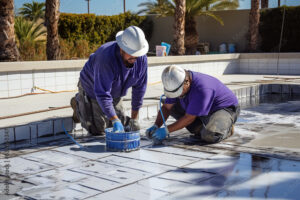
The pool is half drained, the plaster crew shows up Monday, and somebody at the equipment pad asks the question nobody asked in April: do we need a permit for this? The honest answer on pool permit California rules is “usually not for the plaster, possibly for everything else,” and the everything else is where people get caught. If the job is turning into more than a resurface, our pool repairs and upgrades page is where the equipment side of that conversation starts.
California doesn’t have one statewide list that says “replaster: no permit.” Every city and county building department adopts the state code and then decides how to read it. We read the published permit lists for Thousand Oaks, the City of Ventura, the County of Ventura, Camarillo and Simi Valley. Here is what they actually say, and where they go quiet.
A like-for-like replaster (same shape, same plumbing, no new gas or electrical) is not listed as permit-required on any Ventura County city list we found, and exempt lists cover “tiling” and “similar finish work.” The pool permit California cities do require is for new gas lines, new electrical, structural repairs and new features. If a permit is issued for a remodel, state law then requires 2 of 7 drowning safety features and upgraded drain covers, so check with your city first.
This is general information, not legal advice. We are pool techs, not building officials. Only your city or county building department can tell you whether your specific job needs a permit, so ask them before the water comes out.
What the California code says about permits and repairs
The starting point is the California Residential Code, Section R105. Cities adopt it, amend it and print their own version, but the core language is the same. R105.1 in the 2022 edition, the one the local codes below are built on, says anyone who intends to “construct, enlarge, alter, repair, move, demolish or change the occupancy of a building or structure, or to erect, install, enlarge, alter, repair, remove, convert or replace any electrical, gas, mechanical or plumbing system” has to apply to the building official and get a permit first.
Read literally, “repair” is on that list. Then R105.2 carves out exemptions, and R105.2.2 adds that “application or notice to the building official is not required for ordinary repairs to structures, replacement of lamps or the connection of approved portable electrical equipment to approved permanently installed receptacles.” The same section says ordinary repairs don’t include cutting into structural supports, or adding to, altering or relocating water, drainage, gas, electrical or mechanical systems.
The exemption list itself includes “painting, papering, tiling, carpeting, cabinets, counter tops and similar finish work,” and “prefabricated swimming pools that are less than 24 inches deep.” Plaster isn’t named. Whether a new pool finish counts as “similar finish work” or an “ordinary repair” is exactly the kind of call the code leaves to your local building official. (The 2025 edition took effect January 1, 2026, so ask which version your city is enforcing before you quote section numbers at the counter.)
The code never says the word “replaster.” It says “repair” in one place and “ordinary repairs” in another, and the difference is your building official’s afternoon.
What Ventura County cities actually publish
None of these lists mention plaster, resurfacing or replastering on either side.
City of Ventura. Its “Residential Permits Required YES/NO” handout (BS-634, revised January 2020, for detached one and two family homes, and it says “not a complete list”) puts “SPAS AND POOLS all in-ground” on the yes side, adding that electrical and plumbing permits are required for pools and spas that need new electrical or gas lines. On the no side it lists prefab spas, hot tubs and above-ground plastic pools. It also lists “painting, papering, tiling, carpeting and similar finish work” as no permit. The words plaster and resurface don’t appear.
Thousand Oaks. Municipal Code Section 8-4.09 exempts the same “painting, papering, tiling, carpeting, cabinets, counter tops and similar finish work,” plus prefabricated pools at a home that are under 24 inches deep, no bigger than 5,000 gallons and entirely above ground. The Building Division runs pool and spa work through a Pool/Spa Combination Permit application. Its building page lists gas line repairs and electrical service replacements among the permits it handles.
County of Ventura (unincorporated areas). The 2022 Ventura County Building Code, Section 105.2, says “a building permit shall not be required” for painting, papering, tiling and “similar finish work,” and for certain prefabricated pools at single family homes. The county also has a self-certification form for residential alterations that says existing private pools and spas “being improved/modified/altered must be retrofitted” with anti-entrapment covers at the suction outlets. A new pool or spa also needs a Zoning Clearance from the county Planning counter.
Camarillo. We couldn’t find a published exemption list. What Camarillo does publish is a Swimming Pool Safety Act certificate of compliance form that kicks in when “any building permit is issued for remodeling of an existing pool or spa,” signed by the licensed contractor, or the owner-builder, plus the owner, before final inspection. The copy we could open dates from 2007, and the city’s site now lists an updated pool and spa certification, so ask for the current one.
Simi Valley. The Building and Safety forms page lists pool handouts, including pool notes and a pool demolition handout, but we didn’t find a published list that addresses replastering. Call the counter.
Five departments, zero mentions of plaster. That silence isn’t a green light. It’s a phone call.
Pool permit California rules, job by job
The jobs that tend to ride along with a replaster, and what the lists and the code say about each.
| Work type | Permit usually needed? | Source |
|---|---|---|
| Like-for-like replaster, same shape, no plumbing changes | Not listed either way. Exempt lists cover “tiling” and “similar finish work.” Ask your city | CRC R105.2 and R105.2.2, Thousand Oaks 8-4.09, Ventura BS-634, VCBC 105.2 |
| Waterline tile replacement | “Tiling” is on the exempt finish work lists | Ventura BS-634, Thousand Oaks 8-4.09, VCBC 105.2 |
| New gas line to a heater | Yes | Ventura BS-634, CRC R105.1 |
| New electrical circuit for equipment | Yes | Ventura BS-634, CRC R105.1 |
| Light fixture replacement | Yes for the fixture in Ventura. Swapping a lamp is an exempt ordinary repair | Ventura BS-634, CRC R105.2.2 |
| Structural crack repair, new shape or depth, added spa or raised wall | Yes, that is altering the structure | CRC R105.1 and R105.2.2 |
| New in-ground pool or spa | Yes | Ventura BS-634, Thousand Oaks Pool/Spa Combination Permit, County Zoning Clearance |
| Prefab pool under 24 inches deep | No, though new gas and electrical lines still need permits | CRC R105.2, Thousand Oaks 8-4.09, Ventura BS-634 |
| Resurfacing a public pool | Yes, with Environmental Health plan check | Ventura County Environmental Health worksheet |
That last row is the one exception where resurfacing is named outright. Ventura County Environmental Health has a plan check worksheet specifically for “resurfacing or alteration of a public swimming pool,” and it says not to begin construction until plans are approved and a Permit to Construct is issued. Backyard pools don’t go through that worksheet. If you manage a pool the public uses, that’s the office to call.
If you’re weighing a finish refresh against a bigger rebuild, our breakdown of renovation tiers and what triggers each one maps roughly onto this table. The cosmetic tier lives on the top rows.
What a remodel permit drags in with it
Here is why the permit question matters beyond the fee. Once a permit is issued for remodeling a pool at a single family home, two state laws switch on.
Health and Safety Code Section 115922 says that when a building permit is issued for a new pool or spa “or the remodeling of an existing swimming pool or spa at a private single-family home,” the pool has to have at least two of seven drowning prevention safety features. Before final approval, the local building official inspects them. Our post on California pool fence law and the 2 of 7 rule walks through the seven.
Section 115928.5 adds the drains. Whenever a building permit is issued for the remodel or modification of an existing pool, toddler pool or spa, the permit has to require that the suction outlets be upgraded with antientrapment grates meeting the ANSI/APSP-16 standard or its successor.
Budget for the permit’s shopping list, not just the permit. If your project needs a remodel permit, plan for drain covers and two safety features before final inspection. A fence or a set of door alarms is not a surprise you want the week the plaster cures.
The County of Ventura’s pool safety certificate goes a step further in form, asking owners to pick one option from a “Group A” list (power safety cover, enclosure or perimeter barrier) plus additional features from “Group B,” and it cites both Section 115922 and the county’s own building code, VCBC 3109.3. Another reason to ask your jurisdiction and not a blog.
The drain cover question, permit or not
The federal law people mention here is the Virginia Graeme Baker Pool and Spa Safety Act. The Consumer Product Safety Commission says that as of December 19, 2008, public pools and spas must have anti-entrapment drain covers complying with 16 C.F.R. part 1450, and that in 2019 it adopted ANSI/APSP/ICC-16 as the successor standard. That federal rule is aimed at public pools. For your backyard, the California hook is Section 115928.5, on a permit.
Our position is simpler than the law. When the pool is empty, the main drain covers are sitting right there, unscrewed and in your hands. Replace any that are cracked, brittle or not certified, permit or no permit. It is the cheapest safety upgrade in the entire project, and the only time it’s this easy. Our guide to when a pool needs resurfacing makes the same point about fittings and returns.
Who can do the work: licenses and the $1,000 line
The Contractors State License Board defines the C-53 Swimming Pool contractor as one who “constructs swimming pools, spas or hot tubs, including installation of solar heating equipment using those trades or skills necessary for such construction.” That is the license to look for on a pool remodel.
The unlicensed “handyman” exemption went from $500 to $1,000 on January 1, 2025, under AB 2622. CSLB’s bulletin is clear that it only applies if the work doesn’t require a permit and the unlicensed person employs no one on the job. Look at your quote. If the job runs past $1,000, or needs a permit, the person doing it needs a license.
“Our guy doesn’t do permits” is not a pricing strategy. It is a sentence you’ll repeat to an inspector.
On payment, CSLB’s pool construction guidance says to pay no more than 10 percent or $1,000 down, whichever is less. And Section 115924 says anyone contracting to build a pool, or to do permitted work on one, has to give you notice of the Swimming Pool Safety Act requirements. A contractor who brings up safety features before you ask is doing their job.
Questions we get before a replaster
Who pulls the pool permit in California, me or the contractor? Either can apply. Camarillo’s certificate form expects the licensed contractor, or the owner-builder if there is no contractor. Settle it in writing before anything gets drained, because “I thought you were doing it” is how jobs stall.
Is an acid wash a remodel? It’s cleaning, not construction, and none of the lists we read mention it. Our draining and acid washing service is the step before a replaster, or sometimes instead of one.
We’re replacing the heater at the same time. Permit? A new gas line needs one in Ventura, and Thousand Oaks lists gas line repairs among its permit types. A straight swap on an existing line is a question for your city. Our write-up on repairing or replacing a pool heater covers the heater side.
And the pool light? A new bulb is an exempt ordinary repair under R105.2.2. Ventura’s list puts electrical fixture replacement on the permit side. The pool light replacement post explains what’s actually in that niche.
Call the counter with one sentence
Before the pool gets drained, call your building department and describe the job in one sentence: “Replaster an existing residential pool, same shape, no changes to plumbing, gas or electrical, plus new drain covers.” Write down who you talked to and what they said. That one call settles the pool permit California question for your address. If anything on your list touches the bottom half of the table, you already know the answer.
Thousand Oaks Building Division is (805) 449-2320. The City of Ventura Permit Center is (805) 654-7869. Other cities, look up the building and safety counter. The City of Ventura’s permits required list is a good model of the question to ask even if you live elsewhere.
For the pool side of it, the pump, filter, heater and fittings on the pad, send us the details through the site or call (805) 586-2055. We service Pentair, Jandy, Zodiac, Hayward and Sta-Rite equipment.
Replaster coming up?
Find out from your building department whether the job needs a permit before the pool is drained. Then have the equipment on the pad looked at while the pool is empty and everything is easy to reach.
We look at the pool before we quote it.
Primary Pool Services – Ventura County
Thousand Oaks · Westlake Village · Agoura Hills · Camarillo · Newbury Park · Simi Valley · Moorpark · Ventura · Oxnard
Story produced with The Final Code.