How Often Should a Pool Actually Be Drained?
Your test kit knows. The calendar is guessing.
The Rule Of Thumb
Cyanuric Acid Maximum
TDS Over Fill Water
Evaporation Per Week
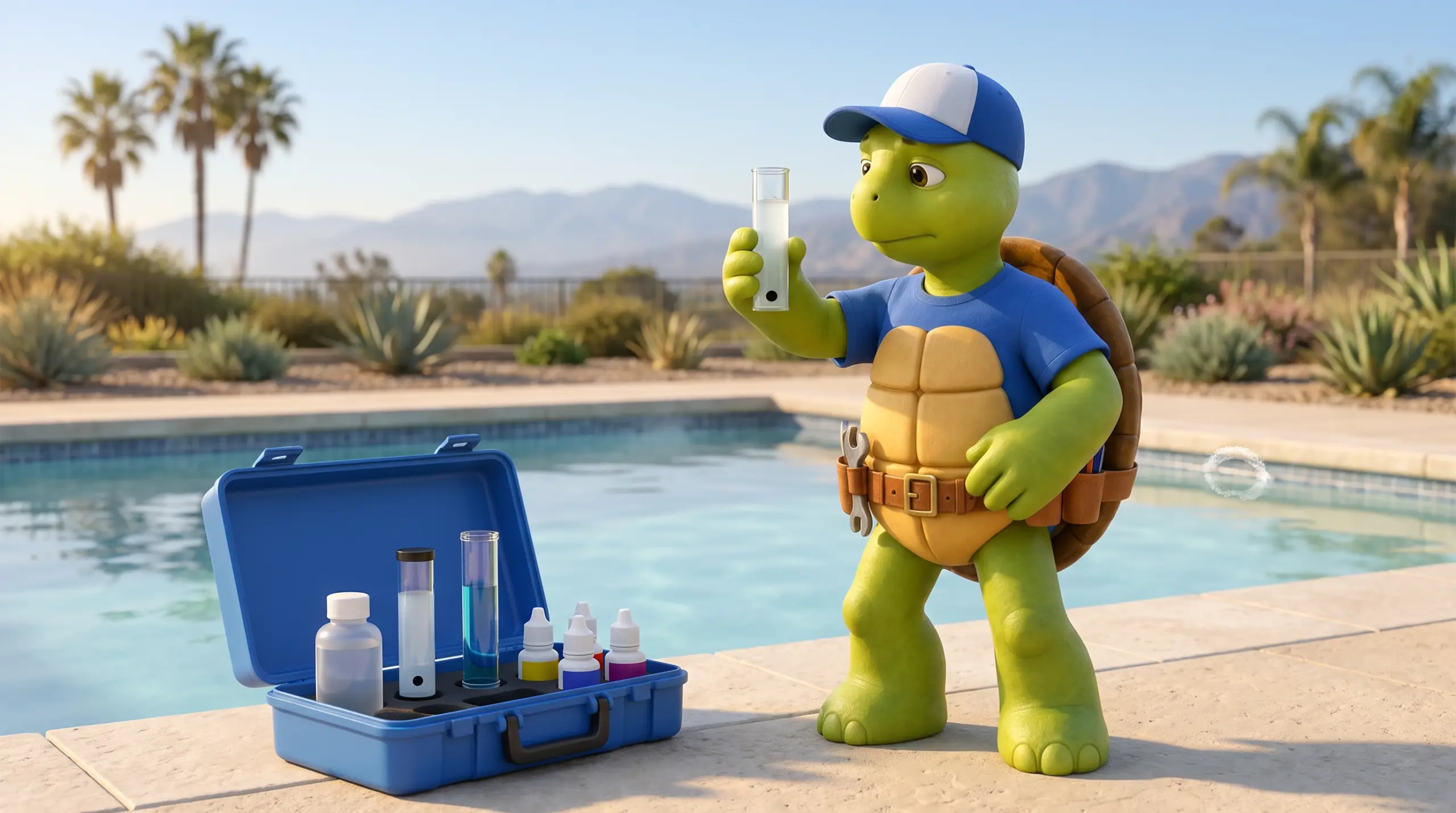
The chlorine reads fine, the pool is hazy anyway, and the bucket of tablets next to the pump is the third one since spring. There is a white crust on the heater union and the tile line looks like a bathtub ring. Nothing in the chemical aisle fixes that pool, because the problem isn’t what’s missing from the water, it’s what has piled up in it. That’s the real answer to how often to drain pool water, and it’s why our pool draining and acid washing service starts with a test, not a date.
Everybody has heard “every three to five years.” It’s not wrong, exactly. It’s an average of other people’s pools. Yours might need it in two years or go eight, and the difference is three numbers you can test for.
Drain when the water tests out, not on a schedule. Cyanuric acid over 100 ppm, calcium hardness approaching 800 ppm, or total dissolved solids about 1,500 ppm above your tap water are the usual triggers. By our own rough estimate, in Ventura County that tends to land in the three to five year range, sooner with chlorine tablets and no cover. Most of the time a partial drain fixes it and a full drain isn’t needed.
What builds up in pool water, and why it stays
Pool water only leaves two ways: it evaporates, or it gets pumped, splashed or backwashed out. Evaporation takes pure water and leaves everything dissolved in it behind. Every top-off brings in more. Every chemical you add leaves something too. Chlorine does its job and disappears, but what it came packaged with stays.
Three of those leftovers are the reasons to drain.
Cyanuric acid (CYA), the stabilizer that keeps sunlight from burning off chlorine. A little is good. Too much makes chlorine sluggish, and the pool starts turning cloudy or growing algae at chlorine levels that should have handled it. It doesn’t burn off and it doesn’t filter out. PHTA’s bulletin on trichlor says that once it passes 100 ppm, the fix is a partial drain and refill.
Calcium hardness, which only goes up in a plaster pool with hard fill water. Too much and it drops out as scale on tile, in heaters and on salt cell plates. You can hold it in solution for a while by running pH and alkalinity lower, which works right up until it doesn’t.
Total dissolved solids (TDS), the sum of everything dissolved: calcium, salt, stabilizer, the leftovers of every bag and jug. TDS is the blunt instrument. It tells you the water is old without telling you exactly what’s wrong with it.
How often to drain pool water: the readings that decide
These are the thresholds the industry actually publishes. The Pool & Hot Tub Alliance (PHTA) wrote the ANSI/APSP-11 water quality standard. It covers public pools, but it’s the standard the whole trade measures against.
| Reading | Level that says drain | Source |
|---|---|---|
| Cyanuric acid | Over 100 ppm. Ideal is 30 to 50 ppm. | PHTA drought fact sheet, citing ANSI/APSP-11. PHTA’s trichlor bulletin says partial drain and refill above 100. |
| Calcium hardness | About 800 ppm or more. 1,000 ppm is the top of the acceptable range. | Leslie’s for the 800 figure. ANSI/APSP-11, via PHTA, for 150 to 1,000 ppm. |
| Total dissolved solids | About 1,500 ppm above your fill water. Salt pools, 5,000 to 6,000 ppm total. | PHTA’s 1,500 ppm TDS increase limit. Orenda for the tap water baseline and salt pool ceiling. |
| Water balance (LSI) | When you can no longer hold it without constant acid. | Orenda |
| Your fill water, Thousand Oaks | Not a trigger. The baseline: TDS 297 ppm, total hardness 140 mg/L. | Cal Am 2025 water quality report |
PHTA’s fact sheet on water conservation during droughts puts the CYA maximum at 100 ppm, calls 150 to 1,000 ppm calcium hardness acceptable, and says calcium is reduced “by draining and replacing an appropriate amount of water.” Nothing clever. Dilution.
TDS alone is the weakest reason to drain. Orenda, the pool chemistry company, says it has not found enough evidence behind the 1,500 ppm rule, and that TDS isn’t really a problem until water balance gets too hard to maintain. We’d drain on CYA or calcium before we’d drain on TDS by itself.
Where “every 3 to 5 years” comes from
Leslie’s, the pool supply chain, puts it plainly: “The general rule of thumb is to drain your pool every three to five years.” Nobody footnotes it, so we ran our own rough numbers. Treat what follows as our estimate, not a published figure.
The California Spa and Pool Industry Education Council estimates evaporation at half an inch to two inches a week, as quoted by the Olivenhain Municipal Water District. Olivenhain’s own example is a 400 square foot pool losing about 19,664 gallons a year. Olivenhain doesn’t give that pool’s volume. At an average depth of 5 to 6 feet (our assumption) it holds about 15,000 to 18,000 gallons, so it evaporates more than its whole volume every year.
Now refill it with Thousand Oaks tap water. Cal Am’s 2025 water quality report lists the main supply (Metropolitan Water District water, 94% of the mix) at 297 ppm TDS. Topping off 19,664 gallons of that into our pool adds roughly 325 to 390 ppm of dissolved solids a year, which reaches the 1,500 ppm mark in about four to five years from top-offs alone. Add chemicals and you get there faster. Add rain, splash-out and backwashing, which dump old water, and you get there slower. Which is about where the rule of thumb lands.
Three to five years isn’t a law of chemistry. It’s roughly how long it takes a pool in a dry climate to evaporate itself into trouble.
Why Ventura County water speeds it up
The same Cal Am report lists total hardness of 140 mg/L (8.2 grains per gallon) for the main supply, and calcium at 31 to 34 ppm. Converted to the calcium hardness scale a pool test kit uses, that’s roughly 80 ppm. By the same rough math, the pool above picks up something like 90 to 105 ppm of calcium hardness a year just from top-offs, before anyone adds cal-hypo shock. That is the calcium behind the white scale line on your tile.
Chlorine tablets are the other accelerator. PHTA says trichlor adds 0.6 ppm of cyanuric acid for every 1 ppm of chlorine it delivers (dichlor adds 0.9). If tablets are covering a chlorine demand of 2 ppm a day, that’s 8.4 ppm of CYA a week. A pool that starts at 40 ppm hits 100 in about seven weeks. (This is how a pool goes from “fine last year” to “algae at 4 ppm chlorine” in one summer.)
Heat and wind push evaporation toward the top of that half inch to two inch range, so a hot, windy inland yard ages its water faster than a foggy one near the coast. Same pool, different birthday.
Partial drain or full drain?
Most pools that test out don’t need to be emptied. They need some of their water replaced.
The math is plain dilution. Replace half the water with CYA-free tap water and a 150 ppm stabilizer reading becomes 75. Replace 40% of a pool at 800 ppm calcium with 80 ppm fill water and you land near 510 ppm. Test first, decide the target, then work out how many inches to pull.
A partial drain keeps water on the plaster and weight in the shell, which removes most of the risk below. A full drain makes sense when the pool is going empty anyway: an acid wash, a resurfacing job, tile work, or readings so far gone that dilution in steps would waste more water than one clean start.
Vinyl liner and fiberglass pools are different. Leslie’s says not to fully drain either one unless you’re replacing the liner, because the liner or shell can bow, crack or shift. Partial drains only.
What can go wrong when you empty a pool
Water is ballast. In The Swim, the online pool supplier, says an average inground pool can weigh 250,000 pounds full, which is enough to hold back most groundwater pressure. Pump it out and the only thing holding the shell down is the shell. If the soil underneath is saturated, the pressure from below can lift it. That’s a “popped” pool.
In The Swim calls it extremely rare, with most cases during major flooding. Their advice is to open the hydrostatic relief plugs in the floor while draining so trapped groundwater can come up into the pool instead of pushing the shell. They also say to pump the water well away from the pool, downhill if you can, so you aren’t soaking the ground you’re worried about.
Then there’s the sun. Leslie’s warns that plaster, vinyl and fiberglass “are not designed to withstand sunlight without water,” and that heat and sun can badly damage an empty pool’s surface. Our acid wash guide covers how long an empty plaster pool can safely sit (short answer: not long).
When not to drain your pool
After heavy rain. In The Swim says don’t drain during extended heavy rain. Leslie’s adds that high groundwater can float or shift an empty inground pool, especially after a storm. If the ground is soaked, wait, or only drain partway.
In a heat wave. Leslie’s says to drain when it’s under 85°F outside when possible, and calls spring and fall the best seasons for a full drain. Don’t pick the second week of a September heat wave because that’s when you finally got around to it.
Because the water is green. Algae is a chlorine and filtration problem. Draining a green pool trades a week of work for a very large water bill and, in some cities, a water quality violation at the storm drain. Fix the green first, then test and see if it still needs draining.
Alternatives that keep most of the water
Reverse osmosis. Pure Water Industries’ Puripool process parks a mobile reverse osmosis trailer at the pool, runs the water through membranes and sends it back. The company says it keeps about 85% of the water, reduces calcium, TDS, CYA and salt, and finishes in less than a day with the pool full the whole time. In 2022 the company announced a Ventura County provider based in Camarillo.
Stop feeding the problem. If CYA is the issue, switch to liquid chlorine or a salt system once the level is back down, so you aren’t adding stabilizer with every dose. PHTA also notes that pool covers reduce evaporative loss, and Olivenhain says a solar cover takes evaporation close to zero. Less evaporation, fewer top-offs, less calcium coming in.
The cheapest drain is the one you put off by five years with a cover and a jug of liquid chlorine.
Where the drain water can legally go
Short version, because the acid wash guide covers it in detail. In Thousand Oaks, the city allows draining to the storm drain if chlorine is at 0.1 ppm or less, pH is between 6 and 8, and the water is free of algae, debris and mosquitoes. You can also pump into your sewer cleanout after notifying Public Works at 805-449-2499.
The City of Ventura does not allow pool water into the sewer at all. Storm drain discharge needs chlorine below 0.1 mg/L, so you dechlorinate first (the city lists time, aeration or sodium thiosulfate), and it asks you to file its MS4 draining form before you start. Saltwater pool water can’t go to the street or the sewer in Ventura and has to be hauled away by truck, which matters if you’re weighing a saltwater system. Check your city before the hose goes anywhere.
Asked at the pad
Do salt pools need draining more often? Not necessarily. Salt is part of TDS, so a salt pool starts high. Orenda puts a salt pool’s practical ceiling at 5,000 to 6,000 ppm TDS. Watch CYA and calcium the same as any other pool.
Should I acid wash while it’s empty? Only if the plaster needs it. An acid wash removes a layer of plaster, and a surface only has so many of those in it.
Get a CYA and calcium number before you book anything
Buy or borrow a test kit that reads cyanuric acid and calcium hardness, or ask whoever services your pool for last month’s numbers. Write down both, plus the date. If CYA is under 100 and calcium is under 800, you don’t need to drain, no matter what year the pool was last filled. If you’re on regular weekly service, that trend should already exist.
If the numbers say drain, send them to us through the site along with what kind of surface you have and whether you’re in Thousand Oaks, Ventura or somewhere else. That tells us whether it’s a partial drain, a full drain, or a drain and acid wash, and which discharge rules apply.
Call (805) 586-2055 and we’ll get a tech out to look at the water before anybody pulls the plug.
Drain it, or just dilute it?
Most pools that test out need a partial drain, not an empty shell. Have your cyanuric acid and calcium hardness readings ready when you call, and we’ll tell you which one yours is.
We test the water before we drain it.
Primary Pool Services – Ventura County
Thousand Oaks · Westlake Village · Agoura Hills · Camarillo · Newbury Park · Simi Valley · Moorpark · Ventura · Oxnard
Story produced with The Final Code.